
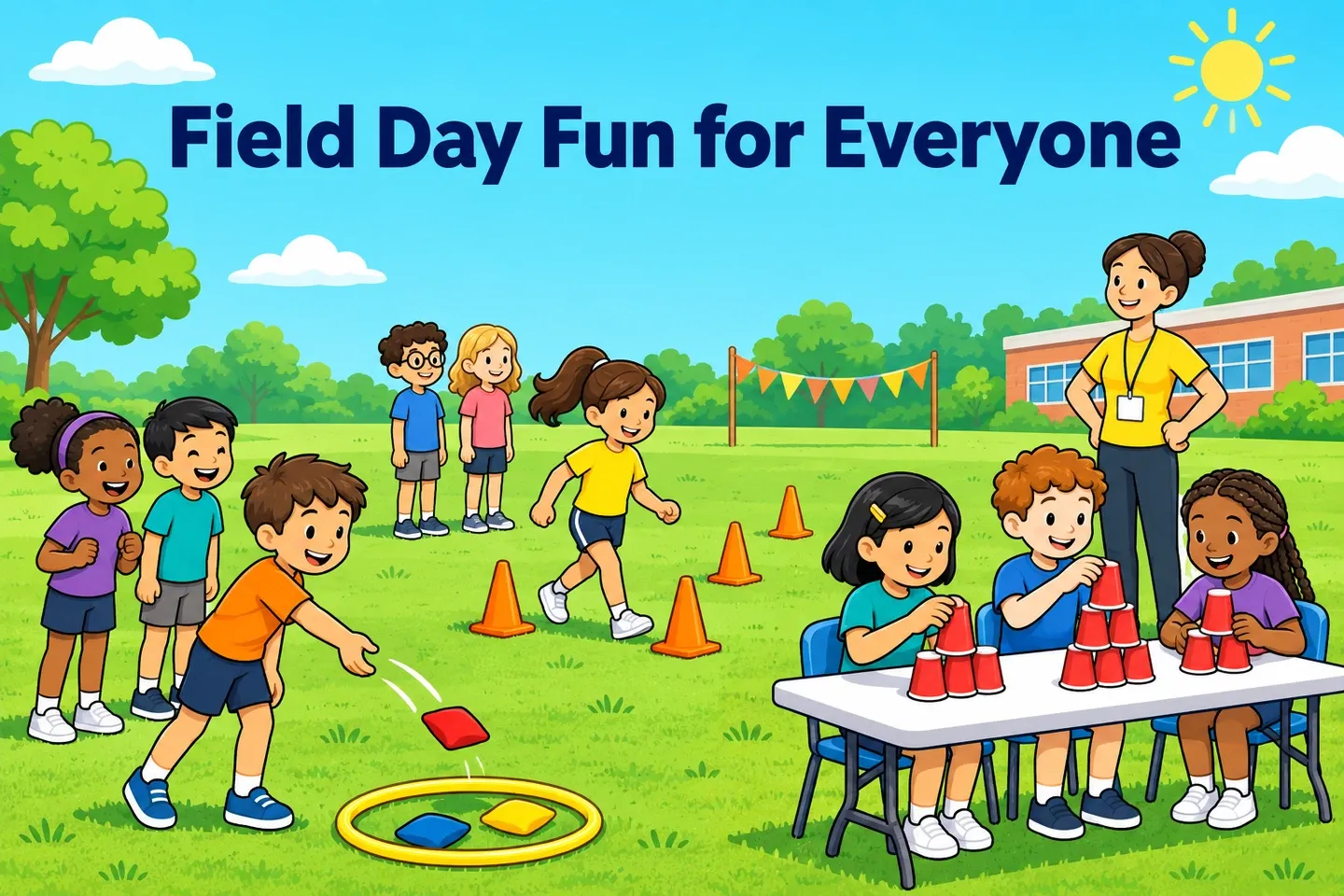
A successful field day needs stations children can understand quickly, enough space to move and a plan for changing activities. Six simple stations are often easier to run than a long list of elaborate races. Give every group equal time, offer seated or lower-movement versions and make resetting part of each station’s routine.
Field day has no single national date. Choose the day with your school or organization, then work backward from its staffing, weather and space requirements. The sample plan below is for six groups of six children, with one adult leading each station and an event lead coordinating transitions.
Set up the rotation before choosing winners
Label stations 1-6 and give each group a different starting station. Use six minutes of activity followed by two minutes to reset and move to the next number, wrapping from 6 back to 1. Six rounds take 48 minutes. Add a ten-minute welcome and ten-minute closing for a 68-minute event, with additional breaks whenever needed.
Do not force a group to continue because a timer is running. Follow your organization’s weather and heat procedures, provide access to drinking water and shade, and have a quiet rest area. Check surfaces, equipment condition and accessible routes before children arrive.
Use cooperative goals or personal improvement rather than an overall leaderboard. Different adaptations make cross-station point totals misleading. If a station uses points, explain its local scoring clearly and let everyone have the same number of attempts in their chosen version.
Station 1: Beanbag target toss
Supplies: six soft beanbags, a flat hoop or shallow target tray, and a throwing line.
Place the target a short distance from the line, then test the distance with your group in mind. Each player gets three underhand tosses. One point counts when a bag finishes fully inside the target; a bag touching the outside does not score. After everyone’s turn, clear the target and try a second round.
Keep all players behind the throwing line until the adult says to collect. Face the station away from walkways. A closer line or a seated toss gives the same basic challenge; choose the distance before the player’s round and keep it consistent for their attempts.
A cooperative goal is to land twelve bags as a group across the two rounds. Adjust that target after a practice turn so it feels achievable, rather than treating it as a test everyone must pass.
Station 2: Cone path delivery
Supplies: five cones, one soft object per lane and two baskets.
Set a wide walking path that weaves gently between the cones. Children carry a soft object from the start basket to the finish basket, then return outside the path. Only one child uses a narrow lane at a time. The next child starts when the lane is clear.
Count successful deliveries together; do not require running. If an object falls, stop, collect it and continue. Space cones for the mobility equipment used by participants. A tabletop version moves an object around small markers with a hand or tool the child can use comfortably.
Station 3: Cup tower team
Supplies: twelve paper cups and a stable table for each pair.
Challenge pairs to build a freestanding tower using all twelve cups. It must stand for five seconds without anyone touching it. Give two minutes to experiment, then invite pairs to explain what made their tower stable.
Reset and try a new condition: build a wide structure, copy a partner’s design or make two matching towers with six cups each. Avoid tallest-tower comparisons between children. Keep the table at a reachable height and allow one partner to describe where pieces should go while the other places them.
Station 4: Roll to the gate
Supplies: a soft ball and two cones for a goal.
Make a wide gate with the cones and mark a rolling line. Each player gets three rolls, aiming to send the ball between the cones. A roll scores one point if the whole ball passes through without moving a cone. A helper returns the ball outside the rolling lane.
Use a seated roll, a closer line or a simple stable ramp when helpful. Agree on the setup before the three attempts. Keep the gate clear of people and use a backstop or spare adult so balls do not travel into another station.
Station 5: Pattern partners
Supplies: six large cards showing simple shapes, two matching sets per pair.
One partner arranges three or four shape cards in a row. The other copies the pattern using their own set, with the original visible. Check together and switch roles. Add a fifth card or hide the original briefly only if both children want a harder round.
Use shapes and position as well as color. This is a quiet seated station that still feels like a challenge. There is no elimination for a mismatch; correct it together and try a new pattern.
Station 6: Group rhythm challenge
Supplies: none, or a few soft percussion instruments used under adult supervision.
The adult demonstrates a three-part rhythm such as clap, clap, tap. The group echoes it together. A child can choose the next pattern, with passing welcome. Build up to four or five actions, then return to an easy pattern for a successful finish.
Offer silent hand motions, table taps or pointing to picture symbols instead of loud claps. Keep sound levels comfortable and do not require standing, jumping or touching another person. The shared goal is to reproduce the pattern together, not catch someone making a mistake.
What each station leader needs
Give the leader a one-page note with the setup, demonstration, stopping rule, adaptation and reset steps. Ask them to demonstrate one turn before the group begins. Keep spare supplies in a central box rather than making volunteers leave their station to search for something.
At the transition signal, children finish the current attempt, return equipment to its starting place and walk with their group to the next number. A helper or clear map prevents groups from crossing active lanes. The event lead should be free to handle changes rather than running a station at the same time.
Rain and small-space options
Move cup towers, pattern partners and rhythm into a classroom or hall with clear aisles. A small target toss or ball roll may work in a suitably sized room, but do not squeeze movement lanes between crowded tables. It is fine to reduce the event to three stations and repeat them with new challenges.
For a warm-weather event built around water, plan a separate activity session with suitable surfaces and supervision. Do not add water to these dry stations at the last minute; slippery floors change how the space can be used.
Finish with what children noticed
Ask each group to name a strategy that helped: taking turns, changing a tower base, choosing a comfortable distance or explaining a pattern. Recognize teamwork and effort without reading out a ranking of children.
If you want handwritten recognition afterward, the Teacher Appreciation and Class Awards pack includes eight repeatable award designs focused on contributions and growth.
For another no-equipment activity, the free HHH game generator can supply prompts for a quiet station. Choose a mode and read the rules before the event so the station leader knows how it works.
Optional supplies
As an Amazon Associate, Happy Holiday Hotspot earns from qualifying purchases. The following Amazon link is a paid link.
Champion Sports color-labeled beanbags can be used for the target-toss and delivery stations. Check the product age guidance and condition before use; soft game pieces you already own may work too.