
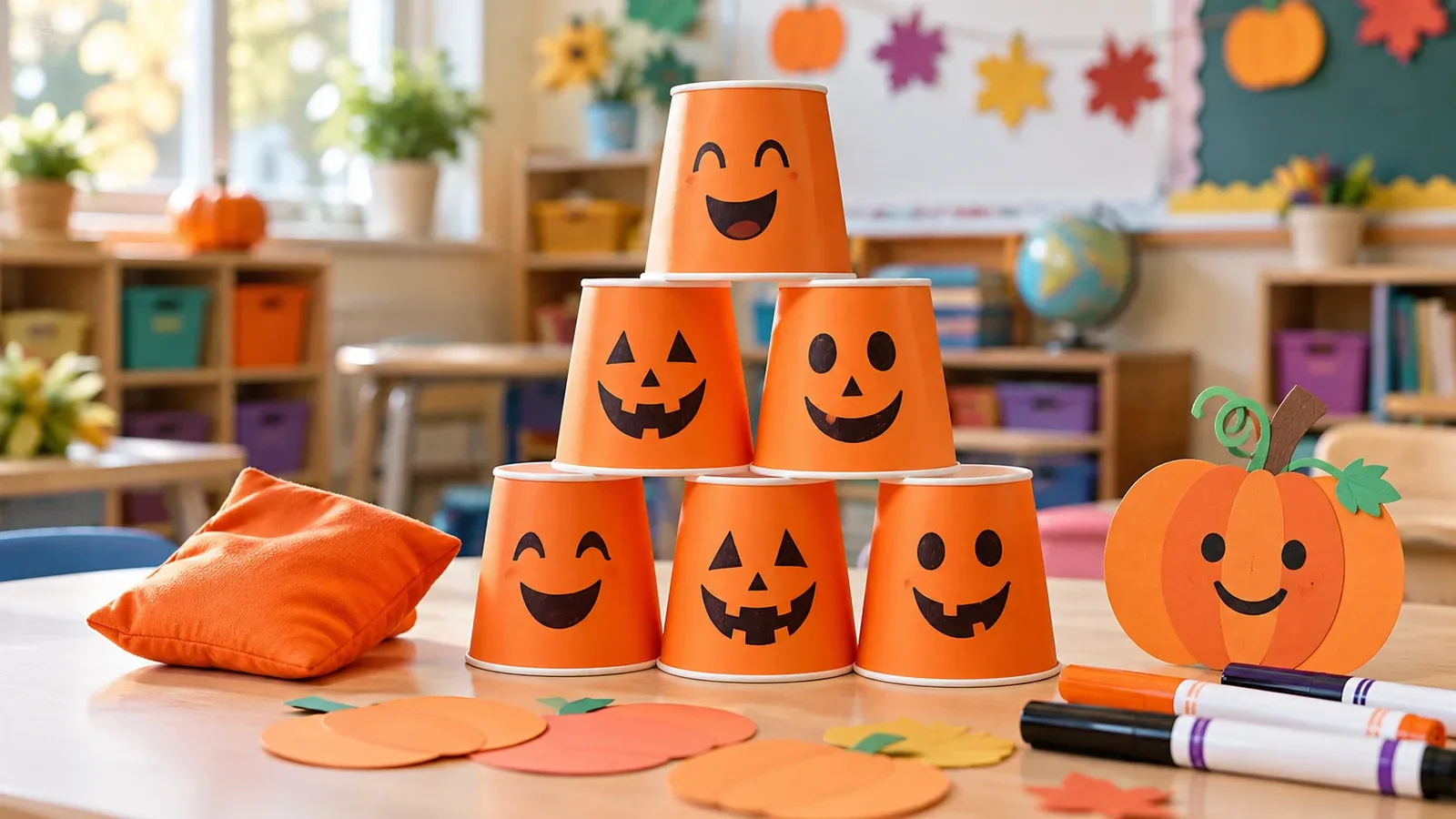
Good Halloween classroom party games are quick to explain, easy to reset, and suited to the space you have. For a simple elementary party, choose a whole-class guessing game, a seated activity, and one small-group station. Halloween charades, a pumpkin memory game, and a soft-beanbag cup game give you different kinds of play without needing a complicated setup.
Below are seven activities you can run from the instructions on this page, followed by printable options from Happy Holiday Hotspot. The no-prep games use spoken prompts and ordinary classroom space; the station games include supplies and setup steps so a teacher or room parent can plan ahead.
Choose your Halloween classroom games
Use the table to match each activity to your class. Times are suggested planning windows, not measured guarantees. Adjust them for your group and allow a little extra time to explain and reset stations.
| Game | Preparation and supplies | Suggested play time | Space and format |
|---|---|---|---|
| Halloween Mystery Clues | No materials; read or invent clues | 4–6 minutes | Whole class, seated |
| Pumpkin Would You Rather | No materials; spoken questions | 4–6 minutes | Whole class, seated or standing |
| Halloween Charades | No materials; spoken prompts | 5–8 minutes | Small groups or whole class |
| Pumpkin Cup Knockdown | Six paper cups, one soft beanbag, table | 5–8 minutes per group | Small supervised station |
| What Disappeared? | Six to eight classroom objects, tray, cloth | 5–7 minutes | Seated group or station |
| Pumpkin Pattern Relay | Paper pumpkin shapes in two colors | 5–8 minutes | Table-based team activity |
| Halloween Freeze and Pose | Leader’s voice; optional music | 3–5 minutes | Standing space or seated variation |
Kindergarten and younger elementary groups usually benefit from shorter rounds, demonstrations, and simple choices. Older elementary students can add harder clues, more complex patterns, or team scoring. Use your knowledge of the class to choose the right challenge.
Halloween classroom games with no prep
These activities can begin with a spoken explanation. You can use the sample prompts below directly or choose your own classroom-friendly Halloween words.
Halloween Mystery Clues
How it works: Give the class a few clues about a Halloween or fall object. Children guess the answer after listening to the clues.
You need: A leader and a list of ideas in your head or on this page. No props are required.
How to play:
- Tell children how they should respond: raise a hand, tell a partner, or wait for the whole-class signal.
- Give one clue at a time, starting broad and becoming more specific.
- Pause briefly between clues.
- Invite guesses, reveal the answer, and begin the next round.
Try these original examples:
| Answer | Clues to read aloud |
|---|---|
| Pumpkin | “I grow on a vine. I can be orange. People sometimes carve a face into me.” |
| Costume | “You can wear me. I help you look like someone or something else. You might choose me for a Halloween party.” |
| Leaf | “I grow on a tree. I can change color in autumn. I might float down to the ground.” |
| Spider web | “I am made of thin threads. A spider makes me. You might use a pretend version as a Halloween decoration.” |
| Trick-or-treat bag | “You carry me. I can hold small treats. You might take me from house to house on Halloween.” |
For younger children, use two simple clues and offer two possible answers. For older children, ask a volunteer to create the clues. A team can earn one point for a correct answer, or the class can play together without keeping score.
Pumpkin Would You Rather
How it works: Children choose between two silly seasonal options and briefly explain their choice.
You need: Spoken questions. Children can answer with a hand signal, a word, or a movement agreed with the teacher.
How to play:
- Explain how to show the first option and the second option.
- Read a question slowly, repeating both choices.
- Give everyone time to choose.
- Invite one or two children to explain their choice, then continue.
Use these original prompts:
- Would you rather decorate a tiny pumpkin or a giant paper pumpkin?
- Would you rather wear a costume with a funny hat or a costume with a cape?
- Would you rather find a purple leaf or an orange acorn?
- Would you rather tell a friendly ghost story or act out a pumpkin growing?
- Would you rather have a costume parade or a classroom treasure hunt?
- Would you rather draw a smiling pumpkin or a surprised pumpkin?
There are no wrong answers and no elimination. For a seated version, use one finger for the first choice and two fingers for the second. Older students can work in pairs to explain their choice before sharing with the class.
Halloween Charades
How it works: One player acts out a seasonal action while classmates guess it.
You need: A leader who gives the actor a quiet prompt. Written cards are optional.
How to play:
- Choose a volunteer or a pair of volunteers.
- Tell them the action without the guessers hearing.
- Explain that they can use gestures but should keep the prompt a secret.
- Let the group guess for a short round, then reveal the answer if needed.
- Rotate to a new actor and prompt.
Try carrying a very big pumpkin, walking through crunchy leaves, trying on a costume, stirring an imaginary potion, hanging a paper decoration, or knocking on a door to say “trick or treat.”
Keep a round to about 30–45 seconds if you want several children to have a turn. Younger children can act in pairs or copy the leader first. A seated actor can show actions with hands and facial expressions. If you use scoring, award one team point for a correct guess and move on without eliminating players.
Halloween games for a small classroom station
Station activities let a small group play while other children enjoy a different part of the party. Place the rules beside the materials and give a helper responsibility for explaining and resetting each station.
Pumpkin Cup Knockdown
How it works: Players toss a soft beanbag at a small pyramid of paper cups and count the cups they knock down.
You need: Six paper cups, one soft beanbag, a table, and a marked throwing spot. Pumpkin faces are optional decoration; plain cups work too.
Set up: Make a pyramid with three cups on the bottom, two above, and one on top. Choose a throwing spot close enough that children can reach the target comfortably. Keep the space behind the target clear.
How to play:
- Give each child one throw from the agreed spot.
- Count the cups that fall from the stack. Award one point per cup, for a maximum of six.
- Collect the beanbag and rebuild the full stack.
- Continue around the group. If time allows, play a second round and add the scores.
For younger children, move the throwing spot closer or use a smaller stack. For a seated variation, put the cups on a reachable table and allow a gentle underarm toss. Use the same starting stack and number of turns for players being scored together.
Reset: Return every cup to the pyramid and place the beanbag at the starting spot before the next turn.
What Disappeared? Pumpkin Memory Game
How it works: Children look at a tray, then try to identify the object the leader removes.
You need: A tray, a cloth or sheet of paper, and six to eight familiar objects. Choose classroom-friendly items such as a pencil, eraser, paper pumpkin, leaf, crayon, glue stick, and small toy.
How to play:
- Show the group the objects and name them together.
- Give children about 20 seconds to look.
- Cover the tray and ask everyone to look away while you remove one item.
- Uncover the remaining objects and invite guesses about the missing one.
- Return the item and repeat with a different choice.
Younger children can start with three or four objects. Older children can identify two missing objects or work with a rearranged tray. Invite children to discuss with a partner before answering if you want everyone involved.
Scoring: Award one point per correctly identified item, or play as a cooperative class challenge.
Reset: Put every object back before the next round so all players begin with the same collection.
Pumpkin Pattern Relay
How it works: Teams take turns extending a pattern made from paper pumpkins.
You need: Pumpkin shapes cut from two colors of paper, a table, and a sample pattern. Cutting the shapes is advance preparation; this is not a no-prep activity.
Set up: Give each team an equal collection of shapes. Start a simple pattern, such as orange-purple-orange-purple, at each team’s table space.
How to play:
- Point to the sample and explain the repeating pattern.
- Each player adds one shape, then gives the next teammate a turn.
- Continue until the team has completed the agreed number of spaces.
- Ask the group to read the pattern aloud and check it together.
For a cooperative game, finish when every team has a correct pattern. For a scored round, award one point for each correctly placed shape. Older students can use a pattern such as orange-orange-purple and explain the repeating unit.
Keep this a table relay: passing the turn along a team is enough. It works without running across the classroom.
Reset: Gather the shapes, rebuild the starting pattern, and give each team the same number of pieces.
A quick Halloween classroom brain break
Halloween Freeze and Pose
How it works: Children make gentle seasonal movements, then freeze in a pose when the leader gives a signal.
You need: A leader’s voice and personal movement space. Music is optional.
How to play:
- Show the movement before beginning: sway like a leaf, stretch like a growing pumpkin, or move your hands like a friendly spider.
- Let children repeat the movement in their own space.
- Call “freeze” and name a pose, such as “a tiny pumpkin” or “a surprised scarecrow.”
- Hold the pose for a few seconds, relax, and choose another movement.
A seated version can use reaching, hand movements, and facial expressions. Keep everyone in the game through every round. This makes a useful short transition between an energetic station and a seated activity.
Printable Halloween classroom party games
The activities above can be played from the article. If you would like a separate printable host guide or a ready-made story activity, these HHH resources give you additional choices.
Five games with supply lists and instructions
Our 5 Halloween Party Games for Kids printable contains:
- Pumpkin Patch Dash: a spoon-and-pumpkin transfer game.
- Lucky Candy Pluck: a hidden-candy picking game.
- Build a Potion: an ingredient-collecting activity using small prizes and treats.
- Rest in Pieces Puzzle Game: a find-and-assemble skeleton activity.
- Boneyard Bounce: a target game using creature hands and ping-pong balls.
The pack includes supplies, how-to-play instructions, and tips or alternative play options. These games need materials and setup. Read the guide before choosing a station so you can gather the right supplies and make adaptations for your classroom’s rules.
Watch the accompanying five-game demonstration to help with your planning. The printable is a paid resource; the product page shows its current price.
Halloween trivia for a seated group
Our Halloween Trivia and Questions resource includes a PDF with 13 question prompts, response pages, and an answer key with fun facts. The PDF instructions refer to presenting the multiple-choice options through the video or slides, so plan how you will show or read those options to your class.
You can use the accompanying Halloween trivia video for presentation. Review the questions first and choose the ones that fit your students and school guidelines. This is a paid printable option.
A left/right story for passing out prizes
The Great Pumpkin Halloween Game has players pass numbered pumpkin pieces while listening for “left” and “right.” At the end, the number each child holds matches a prize bucket. With enough prizes prepared for each numbered group, everyone receives a prize.
For the complete setup and variations, read our Halloween left right game guide.
A simple 30-minute Halloween classroom party schedule
Choose a short opening game, two stations, and a shared finish. This example is a planning suggestion for a class divided into two groups, with a helper at each station.
| Time | Activity |
|---|---|
| First 5 minutes | Explain the plan and play Halloween Mystery Clues together |
| Next 8 minutes | First rotation: one group plays Pumpkin Cup Knockdown; the other plays What Disappeared? |
| Next 2 minutes | Reset and move groups to the other station |
| Next 8 minutes | Second rotation |
| Final 7 minutes | Pumpkin Would You Rather, tidy-up, and a short closing |
A bigger class may need more copies of the materials, additional helpers, or smaller groups. If only one adult is available, choose whole-class games that can be led from the front rather than several stations needing attention at once.
Tell helpers the rules and scoring before children arrive. Keep the next group’s materials ready and use the same signal for stopping, moving, and starting each round.
Adapt the games for your grade and school
For kindergarten and first grade, model a complete turn, use picture cues or spoken prompts, and keep choices simple. Shorter rounds help more children stay involved.
For older elementary students, invite them to write clues, lead a charades round, invent a pattern, or explain their scoring. Increase the thinking challenge before adding more speed or complicated equipment.
For a fall-themed party, use leaves, pumpkins, harvest items, and scarecrows. The mystery clues, memory tray, pattern relay, and movement game all work with seasonal words your school prefers.
If food is not permitted, choose non-food game pieces and rewards suited to the class. Start with the teacher’s guidance on materials, space, and participation so the plan fits the room.
Halloween classroom party game questions
What are easy Halloween classroom games with no prep?
Halloween Mystery Clues, spoken Would You Rather questions, charades, and Freeze and Pose can be played without craft preparation or special props. Read the rules, choose classroom-friendly prompts, and use a clear signal for taking turns.
Which Halloween classroom games work for kindergarten?
Simple guessing clues, two-choice questions, short freeze-and-pose rounds, and a memory tray with three or four familiar objects are useful starting points. Demonstrate the activity and adjust it to your children rather than assuming every kindergarten group needs the same challenge.
How can you organize Halloween party games for a large class?
Start with a whole-class explanation, then divide children into smaller groups for stations. Give each station a helper, clear rules, and reset instructions. Prepare enough equipment for each group and allow time to change places.
Can Halloween classroom games be played without candy?
Yes. The seven games described on this page can use spoken prompts, paper pieces, classroom objects, cups, and a soft beanbag. If you add prizes, choose an option that fits your school’s rules.
Are the printable Halloween games free?
The activities on this page are free to read and use from the instructions. The five-game pack, trivia printable, and Great Pumpkin story are paid HHH resources. Each product page lists its current price and contents.
How long should a classroom party game last?
For the sample plan, allow roughly four to eight minutes for most activities, with shorter movement breaks and extra time for explanations. Treat these as planning estimates and shorten or extend a round according to the class.