
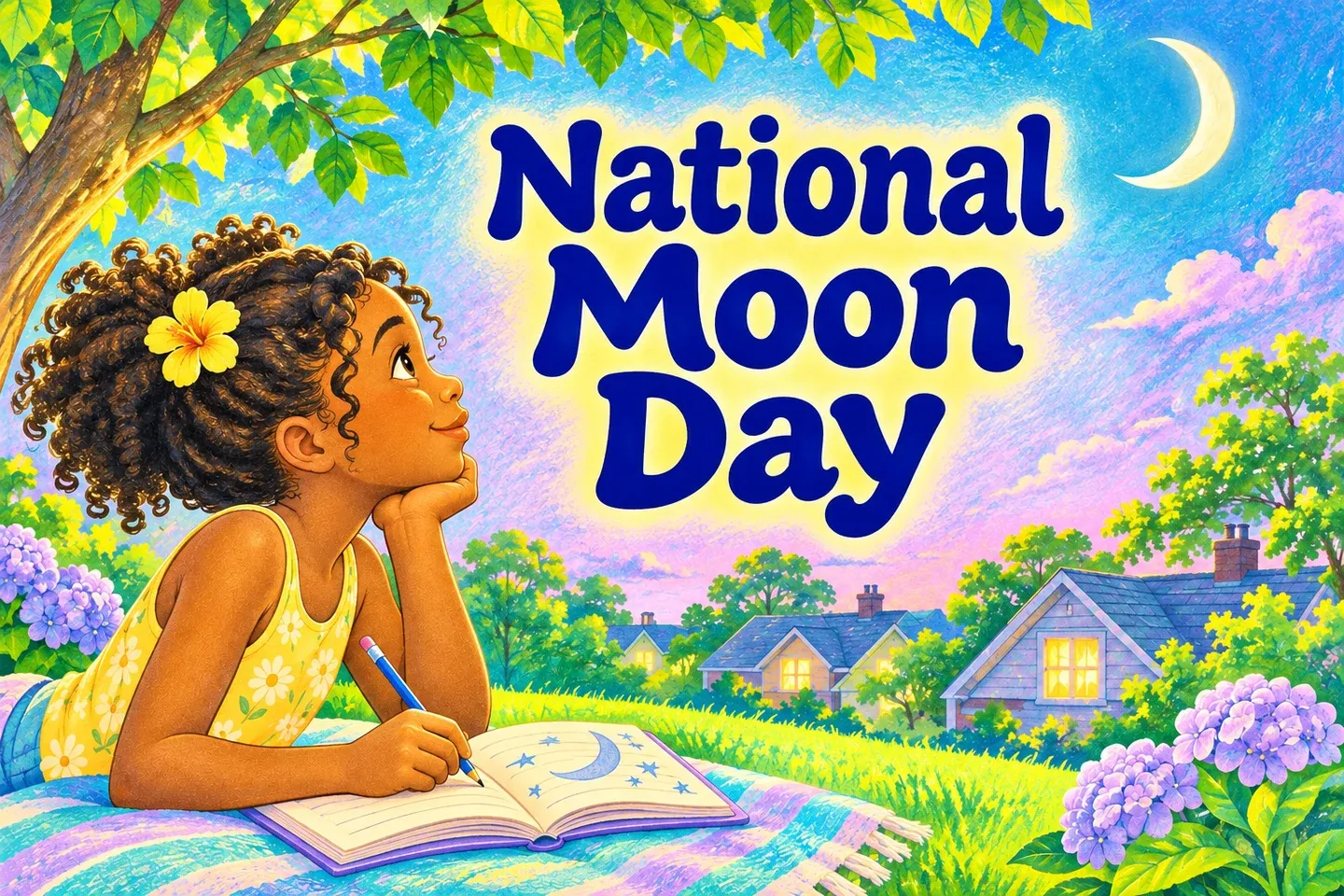
If the Moon is hiding behind a cloud, your young astronomer still has something to put in the journal. Looking up and recording what you actually see is the whole job. A daytime sighting from the driveway belongs there too.
What is National Moon Day?
National Moon Day is July 20, marking the Apollo 11 Moon landing in 1969. It celebrates human exploration and gives families a reason to look up at a world they can see from home.
The anniversary behind the observance
The Apollo 11 landing made July 20 a landmark in human exploration. In 1971, President Richard Nixon designated that year’s July 20 as National Moon Walk Day. Today’s celebration carries forward interest in that achievement and in learning more about the Moon. The 1971 National Moon Walk Day proclamation.
A simple way to enjoy the day
Start a Moon journal, draw the shape you actually see, or explore the mission timeline below. A cloudy evening still counts as an observation; note the weather and look again another day.
Holiday dates for planning
| Observance | 2026 | 2027 | 2028 | 2029 | 2030 |
|---|---|---|---|---|---|
| National Moon Day | Monday, July 20, 2026 | Tuesday, July 20, 2027 | Thursday, July 20, 2028 | Friday, July 20, 2029 | Saturday, July 20, 2030 |
National Moon Day date reference
Piece together a Moon landing
On July 20, 1969, Apollo 11’s lunar module landed on the Moon. Cut out the four shuffled story cards and arrange them by what had to happen first. Talk through the difference between landing the craft and stepping outside. Turn the cards over and draw the scene you would most like to have seen.
Match the Moon shapes
Cut the phase names from the bottom of the page. Match them to the four views, using the amount of the bright face you can see. The sheet uses a Northern Hemisphere view. A crescent is thinner than the half-lit Moon we call a quarter.
Start a seven-night watch
Choose a spot with a clear view and jot down the time whenever you look. Sketch only what you see. If the Moon hasn’t risen or the sky is cloudy, record that instead. Seven entries are a sample of a much longer cycle. Compare the first and last sketches over breakfast.
Get the free printable set
My First Moon Journal includes three US Letter pages. Apollo 11 story sort. Match the Moon phases. Seven nights with the Moon.