
On this page
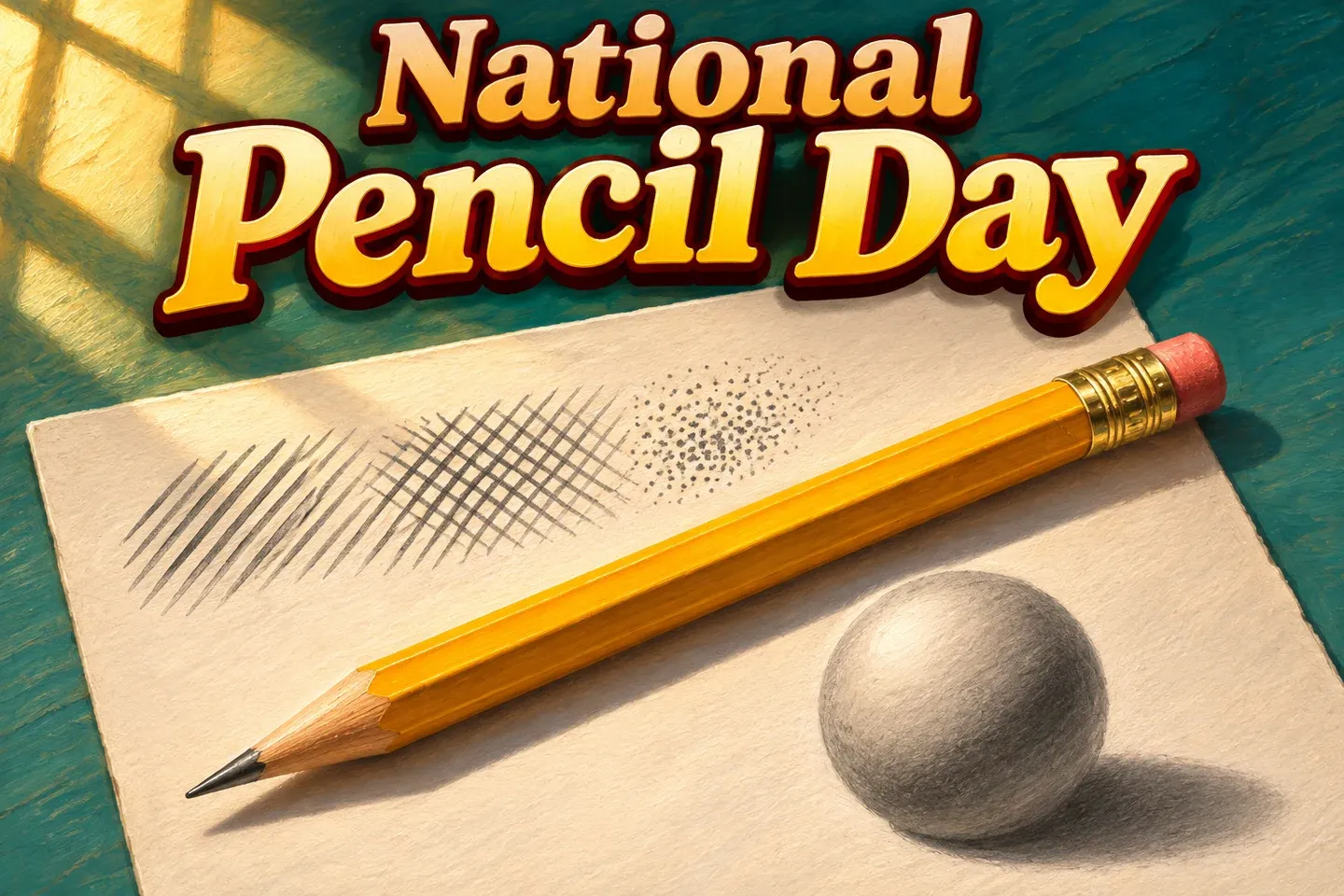
National Pencil Day is March 30. Pick up an ordinary school pencil and make five small patches of gray with it. One patch will be mostly lines, another mostly dots. Look at them from across the table. Can you tell which looks darkest without seeing the individual marks?
Why is Pencil Day on March 30?
Hymen Lipman received a U.S. patent on March 30, 1858, for combining a pencil and an eraser. His design put a piece of rubber into the wood at the opposite end from the graphite. You can see the arrangement in the original patent drawing. Artists had already found another use for a sharp point. By drawing groups of lines close together, they could make flat marks look like shadows. University of Iowa Engineering Library’s pencil history and the Getty’s exhibition on hatching.
Holiday dates for planning
| Observance | 2026 | 2027 | 2028 | 2029 | 2030 |
|---|---|---|---|---|---|
| National Pencil Day | Monday, March 30, 2026 | Tuesday, March 30, 2027 | Thursday, March 30, 2028 | Friday, March 30, 2029 | Saturday, March 30, 2030 |
National Pencil Day date reference
What are five pencil shading techniques for beginners?
Print the pencil shading practice sheets. Use a regular No. 2 or HB pencil and keep the same pencil for every sample. Give each technique a light, middle and dark patch. Leave a little bare paper when you want something to look especially bright.
- Hatching. Draw parallel lines in the same direction. Spread the lines out toward the light. Bring them closer together for the darker patch.
- Cross-hatching. Start with parallel lines. Add a set that crosses them. Keep the second set sparse for a middle tone and build up more lines where you want a shadow.
- Contour hatching. Draw curved lines that seem to wrap around the thing you are drawing. Try them on a circle as if you’re bending the marks around a ball.
- Stippling. Tap the tip lightly to make dots. Leave more space between dots in the light area, then cluster them tightly for the dark patch.
- Smooth shading. Tilt the pencil and brush the side of the graphite over the page. Add a little more graphite with each pass until the dark patch is clearly darker than the middle one.
How do you make a flat circle look like a ball?
Put a round object by a lamp or a window and notice where it looks brightest. On the worksheet, the light comes from the upper left. Keep a light spot on that side of the circle. Build a middle tone across the center and darken the side facing away. Add a soft oval shadow on the table to the lower right. Squint at the drawing. If the bright patch disappears, lift a little graphite with an eraser.
When you’re done, shade another ball with a different set of marks. Which looks rounder to you? Try using the same trick to give a character some depth in a mini comic.
Inside the printable
Practice five kinds of graphite marks in light, middle and dark patches. On page two, study the shaded sphere and try a matching one yourself. Finish by choosing one technique to shade an object from your desk.
Print two US Letter pages at actual size. For personal or group use.