
For a Valentine’s classroom party, choose one whole-class game, one table activity and a quiet finish. A short round of bingo, a paper-heart sorting challenge and a cooperative story can fill half an hour without turning the room into a racecourse.
These games focus on friendship and shared fun. There are no romantic pairings, popularity votes or elimination rounds. Children can pass, watch or work with a helper. Check the teacher’s plans before buying supplies or arranging food; every activity below can be played without candy.
Holiday dates for planning
| Observance | 2026 | 2027 | 2028 | 2029 | 2030 |
|---|---|---|---|---|---|
| Valentine’s Day | Saturday, February 14, 2026 | Sunday, February 14, 2027 | Monday, February 14, 2028 | Wednesday, February 14, 2029 | Thursday, February 14, 2030 |
Choose games that fit your classroom
| Game | What you need | Suggested time | Adaptation |
|---|---|---|---|
| Valentine Bingo | Different cards and pencils or markers | 8-12 minutes | Read and show each call |
| Sort the Hearts | Paper hearts with different symbols | 5 minutes | Keep pieces within seated reach |
| Heart Delivery | Paper hearts, a tray and a box | 5-8 minutes | Pass along the table |
| What’s Missing? | Six classroom objects and a cloth | 5 minutes | Describe objects aloud |
| Draw a Friendly Robot | Paper, pencils and a die | 5-8 minutes | Draw with a partner |
| Kindness Match | Situation slips and a helpful response | 5-8 minutes | Discuss instead of scoring |
| One-Sentence Friendship Story | No supplies | 5 minutes | Say one word or pass |
These times are estimates. Younger children usually need fewer rules and a demonstration before play; older elementary groups can handle extra choices or a second round. Clear paths and keep paper games away from any snacks.
1. Valentine bingo for the whole class
Give every child a different card. Explain the winning pattern before starting: one complete row, column or corner-to-corner diagonal. Read one call, show it, then give everyone time to find it. Children mark a matching space and raise a hand when they have a line.
Check the line against the calls already made. If two children finish on the same call, they both win. Keep playing for more winners if time allows, or reset all cards for another round. Use pencils for a one-time game, or large reusable markers if suitable for the group. Candy is unnecessary.
The Valentine’s Classroom Bingo Pack provides 30 different 5-by-5 word cards, 36 calling cards, a caller checklist and teacher instructions. Each player card has a free center. The cards use short Valentine and friendship words; this is a reading game rather than picture bingo. Read every word aloud and show the calling card for emerging readers.
For more than 30 children, have pairs share a card or run separate tables. Printing duplicate cards in one game can produce identical winners. You can also make your own cards by arranging a shared word list differently on each grid.
2. Sort the hearts
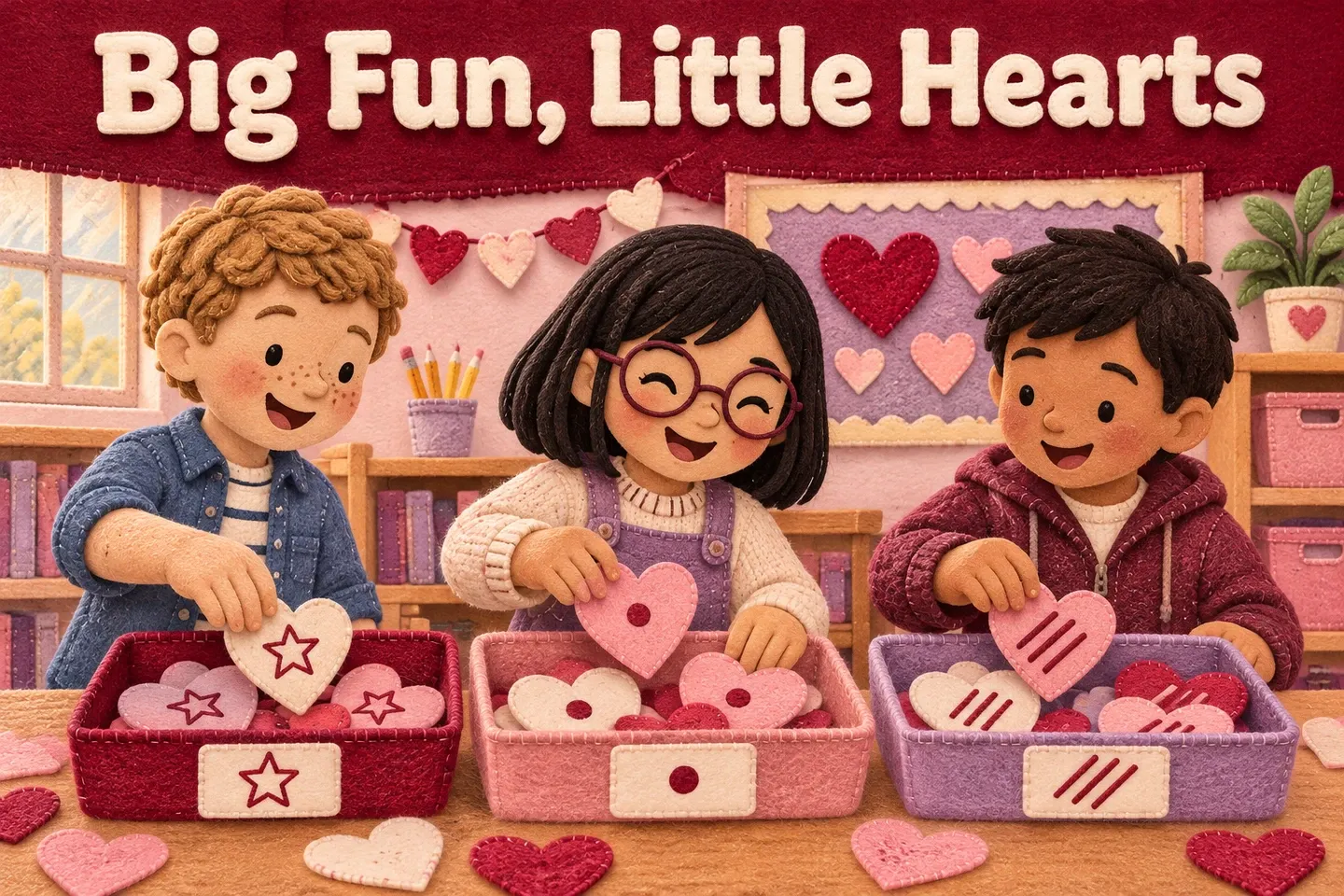
Prepare 18 large paper hearts for each table: six with a dot, six with stripes and six with a star. Use drawn symbols as well as colors so children do not need to distinguish red from pink to play. Place three labeled or pictured sorting areas on the table.
Ask the group to sort the hearts together. When finished, check each pile and count six in each. Mix the pieces and try again with a new rule: put them in a repeating dot-stripe-star pattern. The goal is a complete pattern, not beating another table.
For a harder round, put two features on each heart, such as a symbol and a number. Ask children to sort by one feature, then explain what changes when they sort by the other. For younger groups, use just two shapes and fewer hearts.
3. Heart delivery
Give each table a tray with ten large paper hearts and an empty “mailbox,” which can simply be a small box. Children pass one heart at a time around the table until it reaches the mailbox. Everyone stays in their place.
Set a shared target: deliver all ten without dropping them, helping one another as needed. If a heart falls, pick it up and continue; no one is out. For a second round, reverse direction. A child who does not want to pass can count deliveries or hold the box.
If the teacher wants a movement version, set a short clear walking route and let one child carry the tray at a time. No running, blindfolds or balancing objects in mouths. Keep a seated version available so the activity works for the whole class.
4. What’s missing from the Valentine tray?
Put six familiar objects on a tray: a paper heart, pencil, eraser, crayon, envelope and ribbon. Name each together, then let children look for twenty seconds. Cover the tray, remove one object, and uncover it.
Children quietly discuss with a partner, then offer a guess. Reveal the missing object and return it before the next turn. Play five rounds. Keep it cooperative or give each table one point for a correct answer.
Use four objects for a simpler game or remove two for a harder version. Describe the objects aloud before covering them, and offer two answer choices if open recall is frustrating. Use classroom-approved items large enough to see clearly.
5. Draw a friendly robot
Give each child a sheet of paper and a pencil. Draw a large robot body first, then roll a die six times for the whole class. Each roll adds a friendly detail:
- 1: a heart-shaped button
- 2: a waving hand
- 3: a striped sock
- 4: a flower on its hat
- 5: a big smile
- 6: a pocket for kind notes
A repeated number adds another version of the same detail. Two smiles? One can be on a tiny robot friend. There is no correct picture and no winner. Invite children to name their robot or explain what helpful job it does, with sharing optional.
Pairs can work on one drawing, taking turns choosing where a feature goes. For children who prefer not to draw, describe the robot aloud while a helper draws.
6. Kindness match
Read a made-up classroom situation and ask teams to suggest a helpful response. Use ordinary moments rather than asking children to describe personal problems:
- Someone drops their paper hearts. Offer to help pick them up.
- A new student does not know the game. Explain it or invite them to watch a practice turn.
- Two people want the same crayon. Take turns or find another color that works.
- A teammate gives a wrong answer. Encourage them and keep playing.
- Someone wants a quiet break. Respect the break and leave a way to join again.
There may be several good answers. Accept any respectful response that fits the situation. Give the whole class a point for each situation it solves together, or use it as a discussion without scoring. Avoid naming real classmates in the examples.
7. One-sentence friendship story
Start with: “A tiny robot arrived at our classroom carrying an enormous paper heart.” Go around the group, adding one sentence each. Each new sentence should connect to what happened before it.
Offer gentle prompts when the story stalls: What was inside the heart? Who helped carry it? Where did the robot put it? After five minutes, let the teacher or final volunteer bring the story to a happy ending.
Children may add one word, ask a partner to speak for them or pass. For a large class, tell separate stories at tables so nobody waits through thirty turns. There is no need to write the story down unless the children want to save it later.
A 30-minute classroom party plan
Use this as a starting point for a class of about 24-30 children:
- Minutes 0-3: Show the activities and demonstrate the bingo pattern.
- Minutes 3-13: Play a short bingo round, allowing shared winners.
- Minutes 13-21: Sort paper hearts at tables, then try a repeating pattern.
- Minutes 21-27: Make a friendship story or play Kindness Match.
- Minutes 27-30: Collect pieces, clear tables and thank helpers.
If bingo runs long, stop after the current call and celebrate everyone’s progress. Do not promise that every card will win in ten minutes. For a 45-minute party, add Heart Delivery or the robot drawing activity before cleanup.
Supplies without a long shopping list
Start with classroom paper, pencils, a tray, a cloth and a die. Cut large hearts ahead of time so party minutes go to playing. Put each table’s supplies in a separate envelope or tray, and have a spare set for lost pieces. Use symbols or written words alongside color coding.
As an Amazon Associate, Happy Holiday Hotspot earns from qualifying purchases. The following Amazon link is a paid link.
For decorating the robot drawings or a class thank-you poster, XIANMU foam heart stickers are an optional Valentine-themed extra. Keep the backs on if sorting them, use larger paper hearts for the delivery game, and follow the package age guidance. Ask the teacher whether glitter-finish materials are welcome before bringing this mixed-finish set.
Questions room parents often ask
Which games work without printing?
No-print options include the friendship story, Kindness Match and the memory tray. The robot game only needs blank paper and a die. Hand-cut hearts work for sorting and delivery; prepared downloads are optional.
What should I choose for kindergarten?
Start with heart sorting, the memory tray with four objects, and cooperative delivery. The word bingo is better with reading support or an older partner. Demonstrate one turn rather than giving every rule at once.
How do I keep children included?
Use pairs or table teams, allow passing, and offer a seated role in every activity. Let children choose whether to share a drawing or story. Give any take-home favor to the whole class instead of limiting it to winners.
Can we play without candy or exchanging cards?
Yes. All seven games stand on their own. A paper heart is a game piece, and a kind response is part of the activity; neither requires a gift exchange.
Need a quick backup? The free HHH party game generator includes Color-Object-GO! Children can point to or name a matching object from their seats. For another classroom theme, try our Pizza Day party games.