
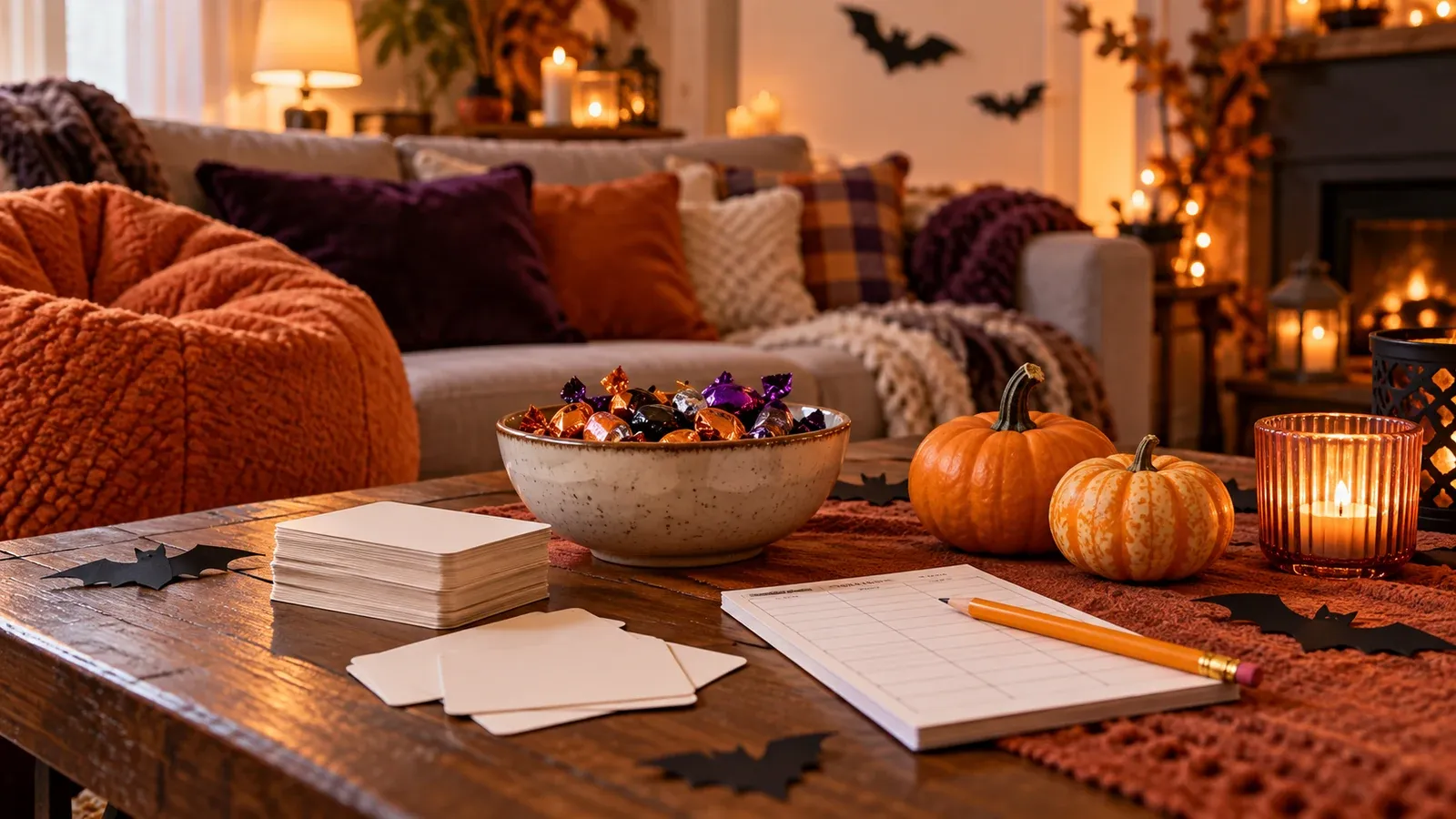
Easy indoor Halloween party games for adults include a spooky category challenge, a partner pumpkin drawing game, a costume guessing game, and a short trivia round. Choose one seated icebreaker, one team game, and an optional activity with a little movement. You can run the seven games below with paper, pens, a timer, and a few ordinary household items.
A living room party does not need a long tournament. Give guests something easy to join, explain one game at a time, and leave room for conversation. These ideas work as a game night, a break between snacks, or a few optional rounds at a costume party. You can play them without drinking rules or elimination.
The group sizes and times below are planning suggestions. Start with one demonstration round and adjust the pace to your guests. If you are still choosing a theme, our 100 adult Halloween party names can help you put the invitation together.
Quick choices for an indoor Halloween party
| Game | Suggested group | What you need | Allow about | Format |
|---|---|---|---|---|
| Costume Character Detective | 4–12, or small circles | Spoken clues; optional paper | 8–12 minutes | Seated guessing |
| Spooky Category Sprint | 2–6 teams of 2–4 | Paper, pens, timer | 10–15 minutes | Team word game |
| Partner Pumpkin Sketch | Pairs, plus a trio if needed | Paper, pens, timer | 8–12 minutes | Seated drawing |
| Who Wrote This? | 4–10 per circle | Matching paper slips, pens, bowl | 10–15 minutes | Conversation game |
| Build a Haunted Story | 4–10 per circle | A starting sentence | 5–10 minutes | Cooperative storytelling |
| Pumpkin Landing | 2–8 per station | Paper targets, soft beanbag, tape | 8–12 minutes | Gentle target game |
| Halloween Memory Challenge | Individuals or teams | Tray, 10 objects, cover, paper | 8–12 minutes | Seated observation |
For a small apartment, start with the drawing, category, and storytelling games. For a larger gathering, run separate circles or stations rather than asking twenty people to wait for one turn. Most rounds can be shortened by giving each player one turn instead of two.
Seated Halloween games for adults
Costume Character Detective
The idea: Give clues about an imaginary Halloween costume while the group works out the character. Guests do not need to arrive in costume to play.
You need: A list of familiar costume characters, such as a vampire, pirate, robot, detective, astronaut, or friendly ghost. A host can keep the list on paper or simply choose each character privately.
How to play:
- Choose one clue-giver and quietly give them a character.
- The clue-giver describes the character without saying its name. Start broadly: “My character might wear a cape.”
- Each guesser may ask one yes-or-no question before the group makes a guess.
- Give another clue if needed. After three clues, reveal the answer and change clue-givers.
- Continue until each willing guest has had a turn.
For a scored team version, give three points for an answer after the first clue, two after the second, and one after the third. Let teams write one answer per clue, then reveal the answer after all three clues. A team earns the points for its earliest correct response, with a maximum of three per round.
The written-answer version avoids a contest to shout first. Keep the characters familiar to your guests and accept a clear equivalent answer, such as “a ghost” for “a friendly ghost.” For a quieter group, let a pair give clues together. To reset, choose a new character and a new speaker.
Who Wrote This? Halloween Edition
The idea: Match a silly Halloween answer to the person who wrote it. This works well when guests know one another a little and want something conversational.
You need: Identical paper slips, pens, a bowl, and a host who reads the answers.
Give everyone the same prompt. Try one of these:
- “My imaginary haunted house would have a room full of _____.”
- “The least frightening thing I could dress up as is _____.”
- “A ghost would be a terrible roommate because _____.”
- “My dream Halloween party would include _____.”
How to play:
- Each person writes a short answer without a name and folds the slip in the same way.
- The host mixes the slips and reads one aloud.
- Guests discuss who might have written it. The writer can listen quietly while the group guesses.
- After a few guesses, invite the writer to reveal themselves and explain the answer if they wish.
- Read the next slip until everyone has been revealed.
Play this one without points. The conversation is the reward, and a guest should not have to defend a personal answer. Use fictional, lighthearted prompts rather than private stories. Guests who prefer not to write can dictate to the host. Collect a fresh set of slips for a second round.
Build a Haunted Story
The idea: Everyone adds one sentence to an increasingly silly Halloween story.
You need: One starting sentence and a comfortable circle. No printed story is required.
Start with: “At midnight, the doorbell rang, but the only thing on the porch was a pumpkin wearing sunglasses.”
How to play:
- The host reads the starting sentence.
- Moving around the circle, each player adds one sentence that continues the story.
- Give everyone a turn before starting another lap.
- On the last lap, ask the final player to bring the story to an ending.
Choose the tone before you begin: funny, mildly spooky, or completely ridiculous. Keep contributions to one sentence so one person does not take over the whole story. A player may pass, and the next person continues. There is no scoring and no wrong ending.
For a smaller group, take two laps. For a larger party, divide into circles and ask each group to share its final sentence. A written version works too: pass a sheet around and have everyone add a line, then let the host read the finished story.
Team Halloween party games
Spooky Category Sprint
The idea: Teams list as many different answers as they can within a Halloween category, then score answers that no other team wrote.
You need: One sheet of paper and pen per team, a timer, and four categories. Try costume accessories, things at a pumpkin patch, Halloween decorations, and things a fictional witch might keep in a cupboard.
How to play:
- Divide guests into teams of two to four and announce the category.
- Give teams 45 seconds to write their answers. Each answer needs to fit the category; variations of the same item count once.
- When time ends, have teams read their lists.
- Cross out answers that appear on another team’s list.
- Award one point for each remaining valid answer and add the team’s total after four rounds.
For example, if two teams write “broom,” neither scores for it. If only one team writes “paper bats” in the decorations round, that team gets one point. Decide before the round whether broad labels and specific examples overlap. You can treat “hat” and “witch hat” as the same answer to keep the discussion simple.
Let the host make the final category decision and move on. For a relaxed version, skip duplicate cancellation and give one point per valid answer instead. Give a team a new category to break a tie, or declare shared winners. Everyone can stay seated, and a teammate can write for the group.
Partner Pumpkin Sketch
The idea: One partner describes a pumpkin picture while the other draws it without seeing the original.
You need: Paper, pens, and a timer. Before the party, the host sketches three simple pumpkin designs and writes a checklist of five features for each.
For your first design, use a pumpkin with a curved stem, two triangle eyes, a square nose, a smiling mouth, and three round dots on its body. The drawing can be simple; the feature checklist makes the score clear.
How to play:
- Sit partners back-to-back or arrange their papers so the drawer cannot see the reference.
- Show the describing partner the host’s drawing and feature checklist.
- Give the pair 60 seconds. The describer explains the picture with words while the drawer sketches.
- Compare the drawing with the checklist. Award one point per recognizable feature, up to five.
- Switch roles and use a fresh picture for another round.
Score the listed features rather than artistic skill. A triangle eye can be crooked and still count. The pair’s score is the total from both rounds, with a maximum of ten. A trio can have two people describe while one draws, then rotate roles. Guests who prefer a quieter version can use written descriptions, and you can remove the timer for an unhurried challenge.
A Halloween game with a little movement
Pumpkin Landing
The idea: Toss a soft beanbag onto flat paper pumpkin targets. It gives guests a short activity without needing a race across the room.
You need: Three large paper pumpkin shapes, removable tape, one soft beanbag, and a score sheet. Mark the pumpkins with one, three, and five points.
Set up: Tape the targets flat on an uncluttered floor, with the one-point pumpkin closest to the throwing spot and the five-point pumpkin farthest away. Choose a comfortable distance for the room. Place the targets separately so the beanbag is unlikely to touch two at once.
How to play:
- Each player takes three gentle underarm throws from the same agreed spot.
- Count the points for a beanbag resting partly or fully on a pumpkin when it stops moving.
- A beanbag touching two targets earns the lower target’s value. A miss earns zero.
- Record the total, collect the beanbag, and reset before the next player’s turn.
The highest possible total is fifteen. Give everyone the same number of turns, then compare totals. A tied group can take one extra throw or share the win. For seated players, set a seated throwing spot and choose the distance together before scoring. If there is no clear floor space, skip the target game and use one of the seated options.
An observation game for small groups
Halloween Memory Challenge
The idea: Guests study a tray of objects, then answer questions about what they saw.
You need: A tray, ten ordinary objects, a cloth, pens, and paper. Include a small pumpkin decoration, purple ribbon, pencil, key, orange paper cup, leaf, spoon, black envelope, wrapped sweet, and a toy spider or paper spider.
Before the game: Write five questions with definite answers. For example: What color was the ribbon? Which item could open a door? How many cups were there? What was beside the spoon? Was the envelope open or closed? Arrange the tray so each answer is clear and record the answers before guests look.
How to play:
- Show the tray for 45 seconds and let everyone look without taking photographs or notes.
- Cover it completely.
- Read the five questions, giving time to write each answer.
- Uncover the tray and check the answers together.
- Award one point per correct answer, with five points available.
For a team round, let partners discuss before writing. Bring the tray close enough for everyone to see, or use fewer, larger objects. A tactile version can give each player the same chance to handle the items before answering questions about them. Change the objects or their arrangement before replaying, and write a matching new answer key.
Add an optional Halloween trivia round
If your guests enjoy a quiz, our Halloween Trivia and Questions resource provides a thirteen-question round. The PDF includes question prompts, response pages, and an answer key with fun facts. Its instructions use the video or slides to present the multiple-choice options, so prepare a way to show those options rather than assuming the response pages contain everything the players need.
The accompanying trivia video is one presentation option. Read the questions and answer key in advance and decide whether the general Halloween questions fit your guests. Use it as a light warm-up if your group prefers easy questions; an experienced trivia crowd may want an extra custom round. The printable is a paid resource, and the product page lists its current price.
For a team version, use one answer sheet per team and award one point per correct answer. Make the rule about phones clear before starting. A tied result can end with shared winners rather than an improvised question with an uncertain answer.
A simple indoor Halloween game-night schedule
This forty-five-minute example includes time to explain the activities. You can spread it across the evening rather than running every game consecutively.
| Time | Plan |
|---|---|
| First 5 minutes | Welcome guests, explain the plan, and form teams |
| Next 10 minutes | Costume Character Detective |
| Next 12 minutes | Spooky Category Sprint, including checking answers |
| Next 10 minutes | Partner Pumpkin Sketch and comparing pictures |
| Final 8 minutes | Share scores, play a short story round, or leave time for conversation |
Put the supplies for each game in a separate small pile. Keep the scoring rule beside the materials, and explain the end of a round before you start. If guests are enjoying the conversation, shorten the next game or leave it optional.
For four to six guests, the story, memory, and partner games are enough for a full evening. For a mixed-age family gathering, swap in familiar characters and pair children with adults. Our Halloween classroom party games offer simpler prompts and school-friendly adaptations. If you want a seated way to distribute party favors, see the Halloween left right game guide.
Indoor Halloween party game questions
What are easy Halloween games for adults indoors?
Category Sprint, Partner Pumpkin Sketch, Costume Character Detective, and Build a Haunted Story are useful starting points. They need little space and use spoken prompts, paper, or pens. Choose games with short turns so guests spend more time playing than waiting.
Which Halloween party games work for a small group?
For four to six people, try the story circle, Who Wrote This?, the memory tray, or partner drawing. Play together or use two teams. You can skip scoring when the group mainly wants a relaxed conversation.
Can you play adult Halloween games without alcohol?
Yes. All seven games here use conversation, drawing, guessing, observation, or a soft beanbag. None needs alcohol, drinking penalties, or a drinking-game format.
What can you play when everyone needs to stay seated?
Use the detective, category, drawing, anonymous-answer, storytelling, and memory games. Bring materials within reach and use written or spoken responses according to the group’s preferences. Pumpkin Landing is the only game here that needs a separate target area.
How do you keep Halloween team games fair?
Explain scoring before the round, give teams equal time and materials, and use the same answer rules for everyone. Rotate speakers and drawers so one person does not do every task. Share a tied win when a tie-breaker would add more waiting than fun.
Are the games on this page free?
The seven activity instructions are free to read and use. The optional Halloween trivia download is a separate paid resource. You can host the evening entirely with the games described on this page.