
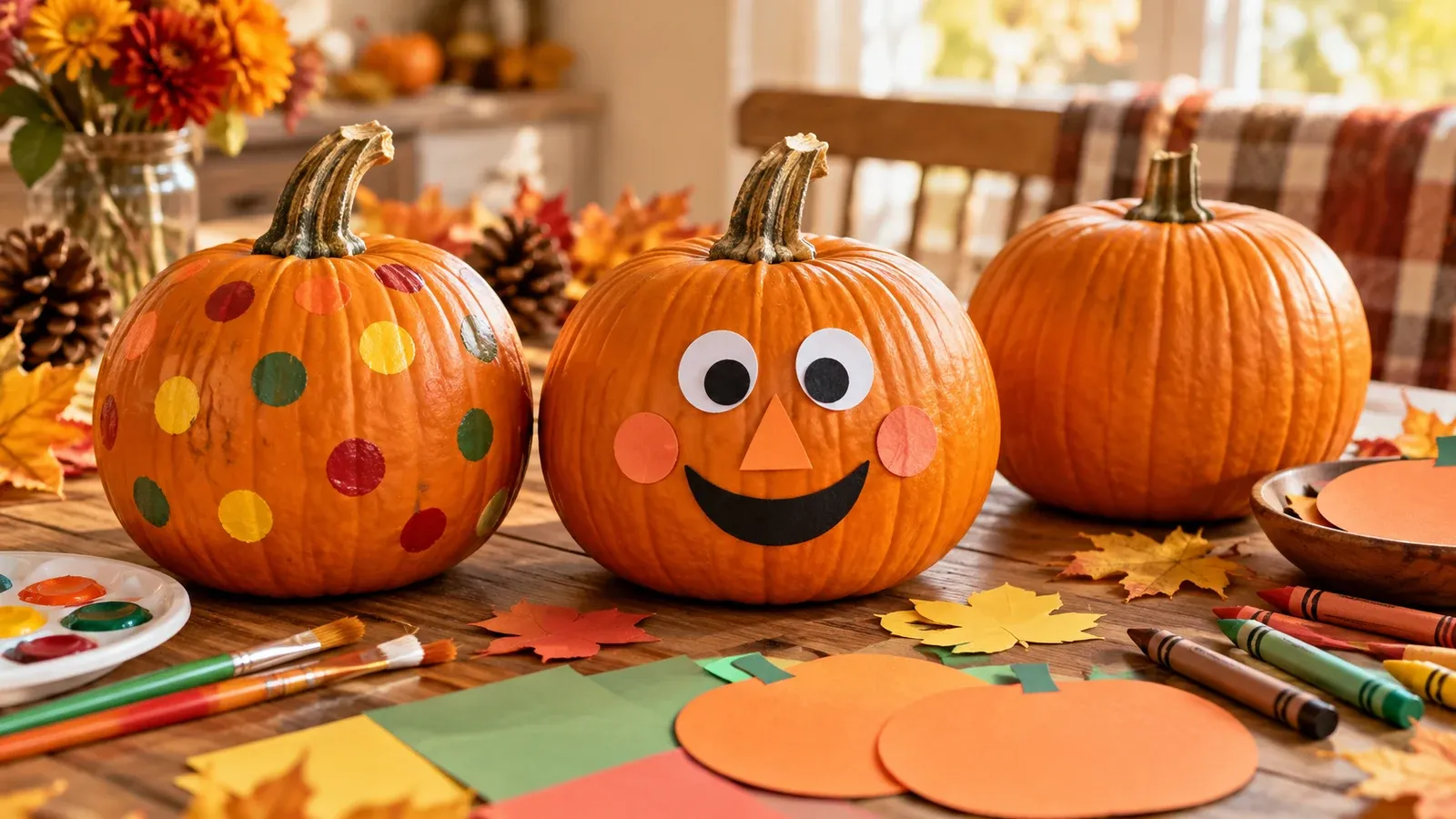
National Pumpkin Day is October 26 each year. In 2026, it falls on Monday, October 26. Celebrate with no-carve pumpkin decorating, a paper-pumpkin craft, a guessing game, or a simple pumpkin observation activity. A few small pumpkins and ordinary craft supplies can become a family afternoon or a classroom celebration.
You do not need to carve a jack-o’-lantern to enjoy the day. This guide focuses on activities children can help shape: designing a face, comparing pumpkins, creating a paper patch, and choosing what happens in a story. Pick one making activity and one game, then finish by showing everyone’s work.
When is National Pumpkin Day?
National Day Calendar lists National Pumpkin Day on October 26. It is an informal seasonal observance, so you can choose how to mark it at home, school, or a community gathering.
For 2026, a Monday celebration can fit into an after-school activity or a short class session. If your family prefers the weekend, arrange your pumpkin afternoon beforehand and mention the October 26 date when you introduce it.
Is Pumpkin Day the same as Pumpkin Seed Day?
No. National Pumpkin Day is October 26. National Pumpkin Seed Day falls on the first Wednesday in October, which is October 7 in 2026. One celebrates pumpkins broadly; the other focuses on their seeds. Keep the two dates separate when you make your October calendar.
Later in the same week as Pumpkin Day, National Candy Corn Day on October 30 offers another simple U.S. celebration for paper crafts and family games.
Choose a Pumpkin Day activity for your group
The times here are suggested planning windows, including a short explanation. A group that enjoys decorating may want longer. Adjust the materials and tasks to the children participating rather than treating the age suggestions as fixed limits.
| Activity | What you need | Allow about | A useful starting point |
|---|---|---|---|
| Paper-Face Pumpkin Studio | Small pumpkins, paper shapes, removable tape | 15–25 minutes | Children who enjoy arranging shapes |
| Painted-Dot Pumpkin Gallery | Pumpkins, suitable craft paint, brushes, table cover | 20–30 minutes plus drying | A supervised craft table |
| Pumpkin Measurement Detectives | Two or three pumpkins, string, ruler, paper | 15–20 minutes | Elementary children or family pairs |
| Build a Paper Pumpkin Patch | Orange and green paper, crayons, glue | 15–25 minutes | Preschool through elementary, with help as needed |
| Pumpkin Clue Trail | Paper pumpkins, clue cards, pencils | 15–20 minutes | A small room, home, or classroom |
| Pumpkin Face Match | Paper face cards and pumpkin outlines | 10–15 minutes | A seated matching game |
| Pumpkin Story Circle | A paper pumpkin and a starting sentence | 5–10 minutes | A whole-group finish |
A no-carve activity keeps the focus on design rather than cutting into a pumpkin. It still needs an adult to organize the materials and help with tools, paint, or cleanup. For young children, prepare large paper shapes and let them choose where those shapes go.
No-carve pumpkin decorating ideas for kids
Paper-Face Pumpkin Studio
The idea: Build changeable faces on real pumpkins using paper eyes, noses, mouths, and other features.
You need: One small pumpkin per child or pair, paper in two or three colors, removable tape, crayons, and scissors for the person preparing the shapes.
Set up: Prepare a tray of large circles, triangles, curved mouths, and rectangles. Wipe the pumpkins clean and dry them. Try the tape on one pumpkin first so you know how well the pieces will stick.
How to make it:
- Invite each child to choose two eyes, a nose, and a mouth.
- Arrange the pieces on the table before attaching them to the pumpkin.
- Tape the pieces in place and look at the expression together.
- Change one feature and notice how the face changes. A smile can become surprised; round eyes can become sleepy.
- Give the pumpkin a name and display it with the other designs.
For preschoolers, offer two choices at a time. Older children can draw and cut their own features or create two different expressions on opposite sides. If you are sharing pumpkins, photograph or sketch each finished design before rearranging the pieces for the next child.
This is a making activity, so there is no need to choose a winner. Ask children what they wanted the face to show and let each design have its own personality.
Painted-Dot Pumpkin Gallery
The idea: Use simple dots, stripes, or repeating shapes to make a collection of decorated pumpkins.
You need: Clean, dry pumpkins, craft paint labeled for the participants and surface, brushes, water containers if the paint requires them, a table covering, and a drying space.
How to make it:
- Give each child a small choice of colors and demonstrate one dot or stripe.
- Have children choose a design before painting: scattered dots, alternating colors, stripes between the ridges, or a ring around the pumpkin.
- Turn the pumpkin gently as needed, keeping freshly painted areas clear of the table and clothing.
- Set it in the drying space and follow the paint label’s drying instructions.
- Once it is dry, arrange a gallery and invite children to describe their choices.
Use larger pumpkins or broader brushes when small details are frustrating. Older children can make an intentional pattern and challenge someone to explain its repeating unit. If paint is unsuitable for the space, draw the same designs on paper pumpkin outlines instead.
A display label can include the artist’s first name and a short title such as “Rainy Pumpkin” or “Purple Polka-Dot Patch.” Keep the materials organized by color and give everyone a place for unfinished work.
A pumpkin observation activity for elementary kids
Pumpkin Measurement Detectives
The idea: Compare a few pumpkins by height, distance around the middle, and visible features. The activity turns “that one looks bigger” into a prediction children can investigate.
You need: Two or three pumpkins, string, a ruler or measuring tape, paper, and pencils. Label the pumpkins A, B, and C so the observations are easy to record.
How to do it:
- Look at the pumpkins without measuring. Ask children to predict which is tallest and which is widest around the middle.
- Measure height from the tabletop to the top of the pumpkin body, leaving out the stem. Use the same approach for each pumpkin.
- Wrap string around the widest part of each pumpkin, mark where the ends meet, and measure that length against the ruler.
- Record the results with the labels A, B, and C.
- Compare the predictions with the measurements and discuss what was surprising.
You can use this simple recording sheet on plain paper:
| Pumpkin | Height | Distance around the middle | Something I noticed |
|---|---|---|---|
| A | _____ | _____ | _____ |
| B | _____ | _____ | _____ |
| C | _____ | _____ | _____ |
Choose one unit, such as inches or centimeters, and use it throughout. Children can work in pairs, with one holding the string while the other records. Younger children can compare short and tall pumpkins or order three by appearance without using numbers.
Finish with a new question: Was the tallest pumpkin also the widest? What changes if you measure at a different place? Encourage children to explain their observations instead of rushing to a single “best” pumpkin.
Paper pumpkin activities for preschool and school
Build a Paper Pumpkin Patch
The idea: Every child makes a pumpkin that becomes part of a shared autumn display.
You need: Orange paper, green paper for stems and leaves, glue sticks, crayons, and a large backing sheet. Prepare pumpkin outlines or pre-cut shapes for children who need them.
How to make it:
- Give each child one pumpkin shape and a stem.
- Invite them to add a face, a pattern, or details from a real pumpkin they observed.
- Glue the stem to the pumpkin and let the pieces settle before moving them.
- Place the finished pumpkins together on the backing sheet.
- Add a sentence beneath each pumpkin: “My pumpkin is _____” or “I would find this pumpkin _____.”
Preschoolers can dictate a sentence to an adult. Older children can write a description or invent a character for their pumpkin. Make the patch a cooperative display rather than a race to finish, and leave room to add pumpkins made by children who join later.
If the display needs to travel home, give each child a separate backing sheet. You can still arrange the finished work together for a temporary gallery before sending it home.
Pumpkin Face Match
The idea: Match a picture of a pumpkin face to the same arrangement of features on a second card.
You need: Six pairs of matching face cards. Draw each face twice on paper pumpkin outlines, keeping the features and their positions the same within each pair. Make the pairs clearly different: happy, sleepy, surprised, winking, worried, and a silly crooked smile.
How to play:
- Mix the cards and place them face up for the first round.
- Let children choose one card and find its matching face.
- Ask them to explain a feature they used: “These both have one closed eye.”
- Remove the matched pair and continue until all six pairs are found.
For a memory variation, turn the twelve cards face down. Players turn over two cards at a time, keep a matching pair, and return a nonmatching pair face down before the next turn. The player with the most pairs wins, or the group can work together to find every match.
Start with three pairs for a shorter or simpler game. For a harder version, make two faces differ by only one feature. The cards are a homemade activity described here, not an included HHH download.
A pumpkin game for a home or classroom
Pumpkin Clue Trail
The idea: Find paper pumpkins by solving clues, then put their letters together to reveal a final word.
You need: Five paper pumpkins marked P, A, T, C, and H; five written clues; and a final gathering spot. Choose places children can reach without climbing or moving furniture.
Place the lettered pumpkins at these locations and read one clue at a time:
- P: “Find the place where stories wait in a row.” Put it by a book shelf or book basket.
- A: “Look beside something that helps us draw.” Put it near the crayons.
- T: “Go where you sit when a story begins.” Put it near the designated chair or reading spot.
- C: “Find a place where paper can lie flat.” Put it on a table or desk.
- H: “Look where we keep what we use to write.” Put it by the pencils.
Explain which areas are part of the game before starting. If your room has several possible places, add a detail to the clue so it points to one clear spot.
How to play:
- Read the first clue and let children discuss the answer together.
- Walk to the spot as a group and collect the letter.
- Continue until all five letters are at the gathering spot.
- Ask the group to arrange them into PATCH.
- Finish by inviting everyone to name one thing they would put in an imaginary pumpkin patch.
For a classroom, let small groups take turns or give each group its own colored set. For children learning letters, show the word PATCH on a sample card so they can match it. This is a cooperative hunt; reset by returning each letter to its original location.
Finish with a pumpkin story activity
Pumpkin Story Circle
Pass a paper pumpkin around a seated circle. Begin with: “Our pumpkin woke up on October 26 and decided to go on an adventure.” Each child adds one sentence before passing the pumpkin to the next person. After everyone has contributed, the leader brings the story home to the pumpkin patch.
Give children the option to pass without speaking or to choose between two suggestions. A younger child might point to a picture while an adult supplies the sentence. Keep the story as friendly or silly as your group wants, and invite older children to write the finished story afterward.
For a separate prepared passing story, our Great Pumpkin Halloween Game uses the words “left” and “right” to move numbered pumpkin pieces around a circle. At the end, each number matches one of five prize buckets. You need one pass pumpkin per player and enough prizes in each numbered bucket for the number of matching pieces.
The four-page paid printable includes supplies, setup and play instructions, and its story. Our Halloween left right game guide explains the numbered-prize setup and other passing variations. The homemade story circle above is a separate activity and does not require that download.
A simple thirty-minute Pumpkin Day plan
Choose activities that fit the materials and helpers you have. This example uses prepared paper shapes, so there is little waiting for supplies or drying paint.
| Time | Activity |
|---|---|
| First 5 minutes | Explain October 26 and look at a real pumpkin together |
| Next 12 minutes | Paper-Face Pumpkin Studio or Build a Paper Pumpkin Patch |
| Next 8 minutes | Pumpkin Face Match or a shortened measurement activity |
| Final 5 minutes | Show the creations, share one observation, and tidy the table |
For a family afternoon, give everyone a role: one person gathers supplies, another makes sample faces, and another chooses the story’s starting sentence. For a school celebration, prepare materials in trays and tell helpers how each activity ends. If you choose paint, allow additional drying time outside the thirty-minute plan.
Pumpkin Day can also be a calm lead-in to a Halloween party. Use the crafts as decorations, then choose a different kind of play from our Halloween classroom party games rather than repeating the same activity twice.
National Pumpkin Day questions
What day is National Pumpkin Day in 2026?
National Pumpkin Day is Monday, October 26, 2026. The date is October 26 each year, while the weekday changes.
What are easy National Pumpkin Day activities for kids?
Try a paper-face pumpkin, a shared paper pumpkin patch, a face-matching game, or comparing two pumpkins. Pick one activity children can make and one they can play, using the instructions and materials that fit your group.
What are good no-carve pumpkin decorating ideas for school?
Paper eyes and mouths, painted dots, stripes, and paper pumpkin designs all work without opening a pumpkin. Prepare the shapes and table space ahead of time, choose suitable materials, and allow drying time if you use paint.
Can you celebrate Pumpkin Day without buying real pumpkins?
Yes. The paper patch, matching cards, clue trail, and story circle use paper pumpkin shapes. A photograph or book picture can provide an observation prompt when a real pumpkin is not available.
Is National Pumpkin Day a federal holiday?
No. It is an informal October observance. It does not appear on the U.S. Office of Personnel Management’s federal holiday schedule. Plan it as an optional activity rather than expecting school or workplace closures.
Is Pumpkin Seed Day also October 26?
No. Pumpkin Seed Day is the first Wednesday in October, which is October 7 in 2026. Pumpkin Day is October 26. A seed-focused activity can fit either celebration, but label the date correctly on your calendar.