
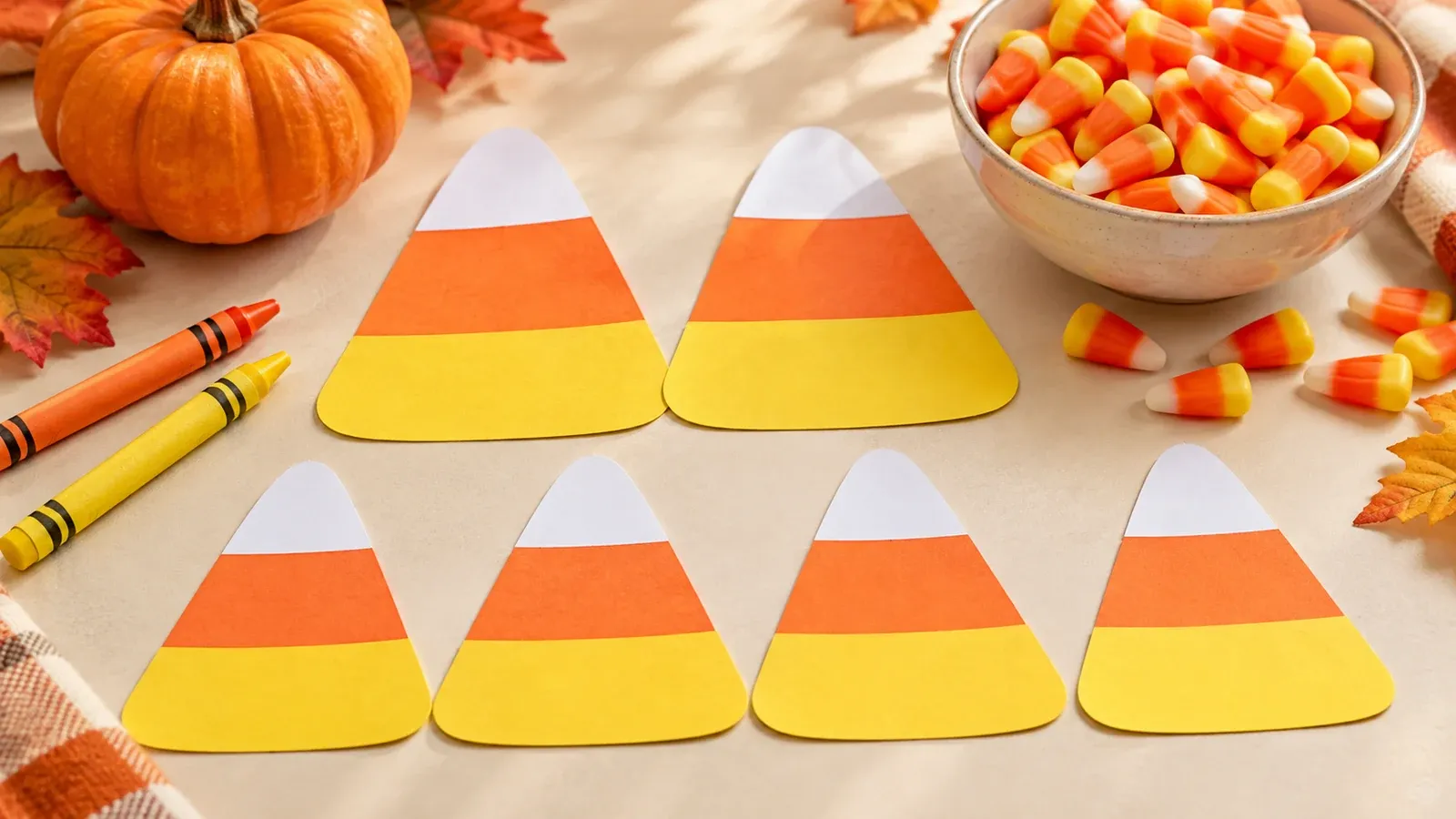
National Candy Corn Day is October 30 each year. In 2026, it falls on Friday, October 30, the day before Halloween. Celebrate with a guess-the-count jar, paper candy-corn crafts, a tabletop pick-up game, or a family word challenge. You can use the familiar white, orange, and yellow design without making edible candy part of the activity.
This guide gives you six games and activities with supplies, rules, scoring where it helps, and variations for different groups. The paper options suit a classroom, a small family gathering, or a party where you already have Halloween snacks planned. Choose one short game and one making activity, then use the finished paper pieces as decorations for the next day.
When is National Candy Corn Day?
National Day Calendar lists National Candy Corn Day on October 30. It is an informal U.S. food observance. For 2026, a Friday celebration can be a short classroom activity or an after-school family game before Halloween on Saturday.
Candy Corn Day is separate from Halloween, even though the dates are close. You can keep October 30 simple and save costumes or a longer party for October 31. The activities below work on either day if that is what your schedule allows.
Pick a candy-corn activity for your group
The times below are planning estimates for one short session. Making the paper pieces is preparation time unless the children are doing it as the activity. A ready-made set lets you begin the games sooner.
| Activity | Supplies | Allow about | Format |
|---|---|---|---|
| Build a Paper Candy Corn | White, orange, yellow paper; glue; crayons | 15–20 minutes | Craft and color-order activity |
| Guess the Candy-Corn Count | Clear container, counted pieces, paper, pencil | 5–10 minutes | Individual or team guesses |
| Candy-Corn Pattern Challenge | Twelve patterned paper pieces per group | 10–15 minutes | Seated cooperative or team play |
| Clothespin Pick-Up | Twelve paper pieces, clothespin, two trays | 5–10 minutes | Tabletop turns |
| Candy-Corn Design Detective | One reference drawing and five comparison cards | 10–15 minutes | Observation game |
| Candy-Corn Word Builder | Paper, pencils, the letters CANDYCORN | 10–15 minutes | Older kids or family teams |
For a group with preschoolers, start with the paper craft, a short pattern, or large drawings to compare. Elementary children can add counting and written answers. For mixed ages, work in pairs and let each person choose a role. These are starting suggestions; your knowledge of the children matters more than an age label.
Make your own paper candy-corn pieces
Traditional candy corn has a small white tip, an orange middle, and a wider yellow base. Draw a large triangle with a slightly rounded tip, then divide it into three horizontal sections. Color the top white, the middle orange, and the bottom yellow.
For reusable game pieces, use paper or card and make each triangle roughly the size of an adult palm. Cut several from the same template so the sizes match. You can make a set from plain white card and color it, or layer colored paper onto a backing triangle.
The games here describe materials you make yourself. They do not require or promise a separate free HHH candy-corn PDF.
Build a Paper Candy Corn
You need: One backing triangle per child, a yellow base section, an orange middle section, a white tip section, glue sticks, and crayons. Prepare the large sections in advance if children need help with cutting.
How to make it:
- Show the group a sample and name its three colors from top to bottom.
- Give each child a backing triangle and the three sections.
- Let children arrange the sections without glue first.
- Check the color order together, then glue the yellow base, orange middle, and white tip onto the backing.
- Add a face, pattern, or small drawing if the child wants a character rather than a plain design.
Younger children can point to the color they want while an adult helps place it. Older children can make their own template, then compare how changing the widths of the bands changes the design. Display the finished pieces together or write one sentence on the back: “My candy-corn character likes _____.”
This is a cooperative making activity, so there is no score. If the group wants a game afterward, mix the finished pieces and see whether everyone can recognize their own design.
Candy-corn counting and guessing games
Guess the Candy-Corn Count
The idea: Estimate how many pieces are in a container, then compare guesses with the actual count.
You need: A clear container, a known number of real candy-corn pieces or paper pieces, slips of paper, and pencils. Use one material consistently so players know what they are counting. Small paper triangles in a clear box are a useful non-food version.
Set up: Count the pieces before putting them into the container. Write the number on a private answer slip. Choose a quantity that fits the group’s counting experience; twenty pieces is a simpler starting point than a tightly packed jar of a hundred.
How to play:
- Show the container and explain that each player gets one guess.
- Give everyone the same chance to look, without opening the container or removing pieces.
- Have players write a name and estimate. Younger children can tell an adult their guess.
- Read the estimates, then reveal the answer and count the pieces together.
- Find the closest estimate by comparing how far each guess is from the true number.
For example, if there are forty pieces, a guess of thirty-seven is three away and a guess of forty-five is five away. The closer guess wins. If two estimates are equally close, share the win or give a new container as a second round. Announce the tie rule before collecting guesses.
To make it a learning activity instead of a contest, let everyone explain their estimate and compare it with the count. Ask whether seeing a second container with ten pieces would help. Reset with a different number before replaying.
Candy-Corn Pattern Challenge
The idea: Complete a repeating sequence using paper candy-corn designs.
You need: Twelve large paper pieces per group: four plain, four with dots, and four with stripes. Each piece keeps the white, orange, and yellow bands; the added pattern makes the sets different. Prepare a sample strip showing the start of a sequence.
How to play:
- Place a plain piece, a dotted piece, and a striped piece in a row.
- Ask the group to describe what repeats.
- Give players turns adding one piece at a time until the row contains all twelve pieces.
- Read the completed sequence together and check each repeating group of three.
- Mix the pieces and choose a new sequence for the next round.
For a younger group, use only plain and dotted pieces in an alternating pattern. For older children, try plain-plain-dotted or ask them to invent a repeating rule another team can solve. Keep it cooperative, or give one point for each correctly placed piece when using equal supplies and the same sample for every team.
Speed is optional. A correct explanation of the pattern is more useful than finishing first with a row no one can describe. For a larger class, set up a tray per table rather than making everyone wait for one shared row.
A tabletop candy-corn party game
Clothespin Pick-Up
The idea: Move paper candy-corn pieces from one tray to another using a clothespin.
You need: Twelve palm-sized paper triangles, a clothespin, two shallow trays or paper plates, a timer, and a score sheet. This game uses paper pieces rather than food.
Set up: Put the twelve pieces in the starting tray without overlapping them. Place an empty destination tray beside it, within comfortable reach. Try picking up one piece first so you know the paper is firm enough and the clothespin easy enough to open.
How to play:
- Demonstrate how to grip the edge of a paper piece with the clothespin.
- Give the player sixty seconds to move as many pieces as possible to the destination tray.
- Use the clothespin for the transfer. A piece dropped on the table stays there until the player picks it up again with the clothespin.
- Count pieces fully inside the destination tray when time ends. Award one point per piece, up to twelve.
- Return all twelve pieces to the starting tray and use the same arrangement for the next player.
For a cooperative version, take turns until every piece is moved, without timing or scoring. Children who find the clothespin uncomfortable can transfer pieces by hand; treat that as its own version rather than comparing scores across different tools. If you use teams, give them the same equipment and number of turns, then add the scores.
The game works seated at a table. Keep each player’s area clear and allow time to reset. Two duplicate stations can reduce waiting for a bigger group.
A candy-corn observation game
Candy-Corn Design Detective
The idea: Find the drawing that matches a reference exactly, then explain the differences in the others.
You need: A large reference drawing and five numbered comparison cards. Use the same basic candy-corn outline and band order on every drawing so the clues come from the details.
Make the reference a candy-corn character with two round eyes, a smile, two orange dots in the middle band, and one short stripe on the yellow base. Make card three the exact match. On the other four cards, change one feature each:
- Card one has one orange dot instead of two.
- Card two has a straight mouth instead of a smile.
- Card four has two short stripes on the yellow base.
- Card five has one square eye instead of two round eyes.
How to play:
- Show the reference where everyone can see it.
- Display all five cards and give players time to compare them.
- Have each person or pair choose a card number.
- Reveal card three as the match and check each detail together.
- Ask the group to explain what changed on the other cards.
For scoring, award one point for the correct match and one for each of the four differences identified, up to five. Accept a spoken description or pointing to the changed feature. For younger children, use three cards with larger, more obvious differences. Older children can draw a new set for the next round.
Make the answer card genuinely identical to the reference; tracing the same outline and copying the details helps. This game works best when the comparison is clear rather than depending on tiny accidental drawing differences.
A candy-corn word game for older kids and families
Candy-Corn Word Builder
The idea: Make smaller words from the letters in CANDYCORN.
You need: Paper, pencils, and a visible copy of CANDYCORN. The available letters are two Cs, two Ns, and one each of A, D, Y, O, and R.
How to play:
- Explain that players may use each letter only as many times as it appears in CANDYCORN.
- Give individuals or pairs two minutes to list words with at least three letters.
- At the end, read the lists and check spelling and letter counts together.
- Award one point for each different valid word. Repeating a word does not add points.
- Compare totals or combine every list into one shared class collection.
Agree before starting whether you will use a dictionary and which kinds of words count. A simple rule is ordinary English words, no people’s names, and no abbreviations. Keep the game to familiar vocabulary if children are still learning to spell.
Some valid starting examples are can, car, cod, con, coy, cry, day, dry, ran, ray, rod, yarn, yard, card, corn, cord, darn, and crayon. Keep these examples covered until after the first round if you want players to find their own answers. For younger children, provide letter cards and ask them to build CAN or CORN from a visible example instead of using a timed challenge.
Adults and children can form mixed pairs, with one person suggesting a word and another checking its letters. To replay fairly, choose a new seasonal word rather than using CANDYCORN again after everyone has seen the answer examples.
A simple twenty-five-minute Candy Corn Day plan
Prepare the game pieces before the session if you want to spend more time playing. This example combines a quick guessing activity with a craft and a cooperative finish.
| Time | Activity |
|---|---|
| First 5 minutes | Explain October 30 and collect guesses for the count container |
| Next 12 minutes | Build a Paper Candy Corn, with prepared sections |
| Next 5 minutes | Play a short Pattern Challenge or compare Design Detective cards |
| Final 3 minutes | Reveal the count, show the finished crafts, and tidy up |
For a family game night, give each person a turn at Clothespin Pick-Up and add the word challenge for older players. For a classroom, set out materials by table and choose a shared stopping signal. All of the paper activities can be played without handing out edible candy.
If you do want treats at home, keep them separate from the game pieces and choose what fits your guests. At school, follow the teacher’s food and activity guidance. You can also use non-food rewards or simply end by displaying the group’s work.
Pair Candy Corn Day with your other October plans
National Pumpkin Day activities on October 26 give you an earlier making session. The pumpkins and paper decorations can then be used for October 30 or Halloween on October 31.
For a longer children’s party, add a game with a different format from our Halloween classroom party games. For an adult evening, use the indoor Halloween games guide and choose a name from our Halloween party names and invitation examples.
The Halloween left right game guide is another option when you want a seated way to distribute treats or party favors. Its numbered-pumpkin setup is separate from the homemade candy-corn games above. Pick the activities that suit your gathering rather than trying to use every idea at once.
National Candy Corn Day questions
When is National Candy Corn Day in 2026?
National Candy Corn Day is Friday, October 30, 2026. The annual date is October 30, one day before Halloween.
What are easy candy-corn games for kids?
Try a guess-the-count container, a paper pattern challenge, Clothespin Pick-Up, or Design Detective. The instructions above explain materials, complete rules, and optional scoring. Prepare large paper pieces when you want a non-food version.
Can you celebrate Candy Corn Day without eating candy?
Yes. Use white, orange, and yellow paper triangles for the craft and games. Paper pieces work for counting, patterns, observation, and tabletop transfers. The word challenge only needs paper and pencils.
What are the colors of traditional candy corn?
The familiar design has a white tip, an orange middle, and a yellow base. Use that order when making the paper shapes for these activities, then add dots, stripes, or faces to create different game pieces.
Is Candy Corn Day a national holiday with school closures?
It is an informal U.S. national day, rather than a federal holiday. It does not appear on the OPM federal holiday schedule. Follow your school or workplace calendar for closures.
Is there a free candy-corn printable included with this article?
This article provides free instructions for making the paper pieces and playing the games. It does not include a separate downloadable candy-corn PDF. You can draw a simple template and create the materials described here with ordinary craft supplies.