
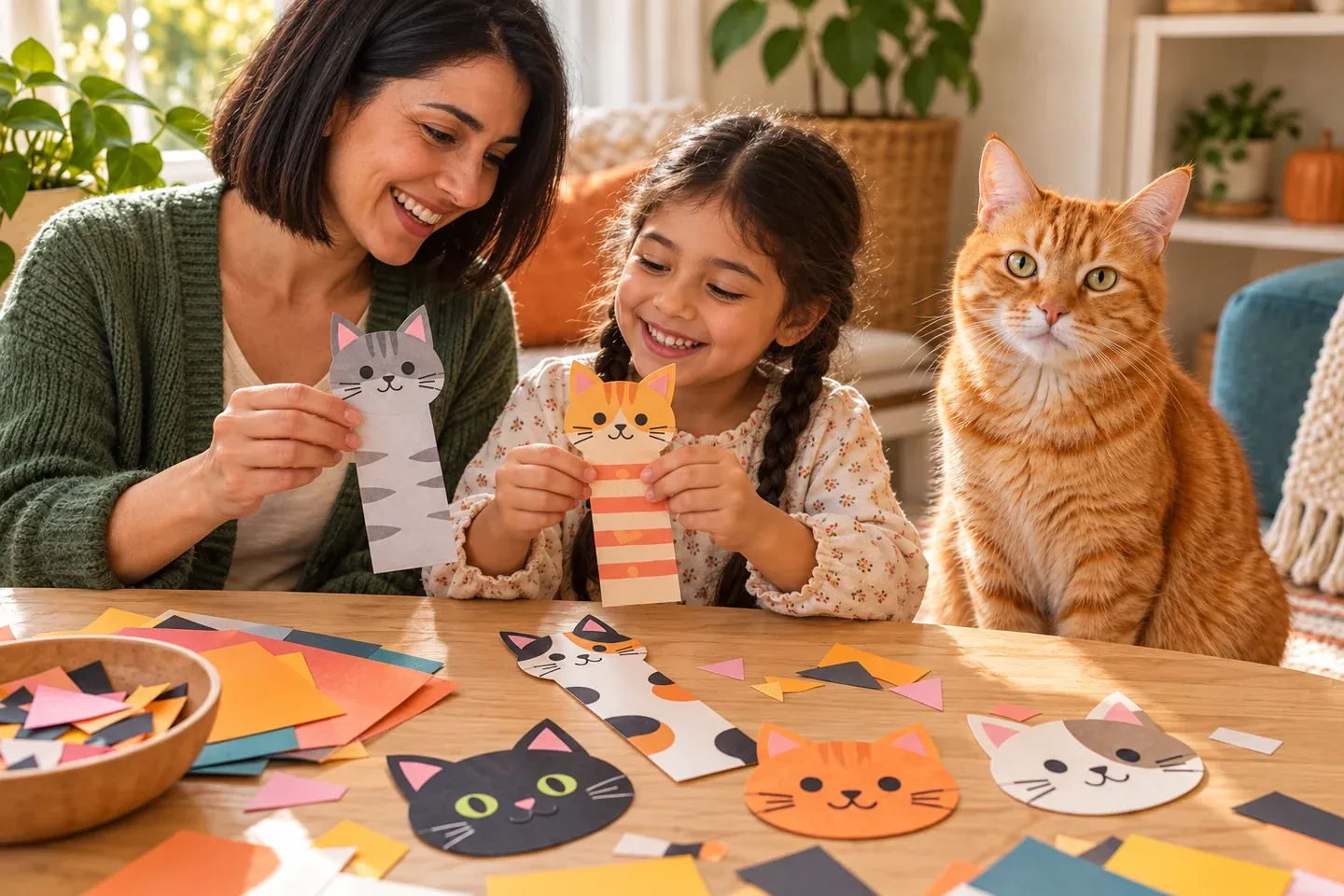
U.S. National Cat Day is October 29 each year. Celebrate with a paper cat craft, a family game, or a project that helps a local shelter. You do not have to own a cat to take part, and a classroom celebration can work entirely with paper, pictures, and pretend play.
This guide gives you three complete crafts, three games, a free printable craft template, and a step-by-step shelter-support plan. The activities are for people; keep craft supplies separate from pets and let any real cat enjoy its own comfortable space.
When is National Cat Day, and what does it celebrate?
The National Cat Day organizer identifies October 29 as its annual celebration. Founded by Colleen Paige in 2005, the day encourages appreciation for cats and awareness of cats needing homes. A thoughtful celebration can include both something fun and something useful for a shelter.
Holiday dates for planning
| Observance | 2026 | 2027 | 2028 | 2029 | 2030 |
|---|---|---|---|---|---|
| National Cat Day (U.S.) | Thursday, October 29, 2026 | Friday, October 29, 2027 | Sunday, October 29, 2028 | Monday, October 29, 2029 | Tuesday, October 29, 2030 |
National Cat Day (U.S.) date reference
Is National Cat Day the same as International Cat Day?
No. This article follows U.S. National Cat Day on October 29. International Cat Day is August 8, according to International Cat Care. The UK’s National Black Cat Day is October 27, organized by Cats Protection. Those are separate observances with different names and dates.
You can use the crafts on another day, but label an event with the correct observance. For a school group, introduce October 29 as an optional themed activity rather than a holiday that changes the school calendar.
Choose a cat activity for your group
Start with one craft and one short game. The suggested times include making or playing, but preparation and drying can take additional time. Adult helpers can cut large shapes in advance when children are still learning to use scissors.
| Activity | Main materials | Allow about | A useful starting point |
|---|---|---|---|
| Long Cat Bookmark | Cardstock, crayons, scissors | 15–20 minutes | Individual craft |
| Folded Paper Cat Portrait | Paper, glue stick, crayons | 15–20 minutes | A classroom display |
| Paper Cat Ears Headband | Paper strips, tape, ear shapes | 10–15 minutes | Pretend-play opening |
| Cat Charades Circle | Spoken prompts or paper cards | 10 minutes | Family or classroom game |
| Find the Matching Cat | Six homemade card pairs | 10–15 minutes | Quiet small-group play |
| Draw a Cat from Clues | Paper and pencils | 10 minutes | Cooperative listening activity |
| Shelter Wish-List Project | A confirmed wish list and collection boxes | Several short sessions | A family or class service project |
If anyone prefers not to wear a headband, invite them to make it for a paper drawing or choose the bookmark instead. Make movement games optional and offer a seated version. Cat Day should be easy to join without a costume, a pet, or a donation.
Free printable cat craft template
Our free cat craft template contains a long bookmark outline, a round cat-face outline, and ear triangles with fold tabs. Add the one-page PDF to your cart, then enter your name and email to receive the download link. No payment is needed for a cart containing only free items.
Print in portrait orientation and choose Fit or Fit to page for A4 or U.S. Letter paper. You can also draw the shapes yourself using the measurements below. Ordinary paper works for practicing; cardstock makes a sturdier finished bookmark.
Cat crafts for kids: complete instructions
Long Cat Bookmark
You need: One piece of cardstock, a pencil, crayons or markers, scissors used with appropriate help, and optional glue for a second layer. Allow: 15–20 minutes. Finished shape: A long body with a cat head and two ears at the top.
- Print the bookmark outline or draw a body about 2 inches wide and 5 inches long. Above it, add a rounded head with two triangle ears, making the total length about 6 inches.
- Cut around the outside of the whole shape. Do not cut the head away from the body.
- Draw the face: eyes, a small nose, a mouth, and short whisker lines. Use crayons for whiskers rather than attaching string.
- Decorate the body with stripes, spots, or a solid color. Leave an area for the cat’s name if you want one.
- For a stronger bookmark, glue the finished shape to another piece of cardstock, allow the glue to dry, and trim the backing to match.
- Place the bookmark between pages of a book, with the head showing above the page.
For younger children, an adult can prepare the outline and offer large crayons. Older children can design front and back views or add a short book recommendation to the body. Do not glue on bulky pieces that might damage a book or turn the bookmark into a pet toy.
Invite children to explain one design choice: “My cat has stripes because…” or “My bookmark likes adventure books.” This turns the display into a conversation without judging whose craft is best.
Folded Paper Cat Portrait
You need: A sheet of paper, a cat-face outline, two large paper triangles, crayons, a glue stick, and a backing sheet. Allow: 15–20 minutes, plus any drying. Group: Individual artists or pairs.
- Use the round face on the template or draw a circle about 4 inches across on colored paper.
- Cut out the face and two triangle ears with help as needed.
- Fold the bottom of each triangle back by about half an inch. This small folded tab will sit behind the face.
- Glue the tabs behind the upper left and upper right of the circle so the triangles project above it.
- Draw eyes, nose, mouth, and whiskers on the front. Add a small triangle of color inside each ear if desired.
- Glue the finished face onto a backing sheet. Write a name and one imaginary fact about the character beneath it.
The portrait can be as realistic or silly as the maker wants. A child might create a sleepy orange cat, a purple library cat, or a cat that supposedly runs a bakery. Frame imaginary facts as storytelling, not as information about real cat care.
For a group display, use the same backing size so the portraits fit together. Add a title such as “Our Cat Day Gallery,” and let each child choose whether their name appears. Keep these paper portraits in the human craft area, away from animals.
Paper Cat Ears Headband
You need: Two paper strips about 2 inches wide, two large ear triangles, crayons, and tape. Allow: 10–15 minutes. Preparation: An adult should help fit and secure the band.
- Decorate the two ear triangles with an inner-ear shape and any chosen colors.
- Tape the paper strips together into one long strip. Fit it loosely around the wearer’s head and mark where the ends overlap.
- Remove the strip, then tape the overlap into a ring. Check the fit again; it should sit comfortably without squeezing.
- Fold a short tab at the bottom of each triangle and tape the tabs to the inside front of the ring.
- Invite the wearer to try it, adjust the ear placement, and remove it whenever they want.
Use tape rather than exposed staples. For someone who does not want to wear it, make a smaller ring for a drawing or display. These are children’s pretend-play headbands; do not put them on a real cat.
Have a paper recycling bin ready for offcuts and store finished crafts where pets cannot reach them. A calm cleanup makes it easier to move from crafts to games.
Cat games for families and classrooms
Cat Charades Circle
You need: No materials, or prompt cards if helpful. Allow: About 10 minutes. Group: A small family or a class divided into groups.
Use these pretend actions: stretching after a nap, looking out a window, hearing a surprising sound, curling up to sleep, looking for an imaginary toy, and walking through pretend tall grass.
- Choose one player to act, with the option to pass or partner with someone.
- Quietly tell the player one action. For non-readers, demonstrate or describe it without expecting them to read a card.
- Give the player up to thirty seconds to act. Keep movements within their own space; no crawling under furniture or chasing classmates.
- Let the group guess the action, then reveal it and change actors.
- Continue for one round per willing participant or until your planned time ends.
Make this cooperative: count how many prompts the group solves together. If you want teams, alternate turns and award one point for a correct guess, with equal numbers of prompts for both teams. A seated actor can use hands, facial expressions, or a drawing instead of whole-body movement.
Find the Matching Cat
You need: Twelve cardstock cards and crayons. Allow: 10–15 minutes. Group: Two to four players per set.
Draw six pairs of cat faces. Give each pair a clearly different feature: orange stripes, gray spots, a black patch, long whiskers, closed eyes, or a large drawn bow. Keep the backs alike. These are illustrations, so a bow is a design detail rather than an instruction to dress a pet.
- Shuffle the cards and place them face down in three rows of four.
- Players take turns turning over two cards.
- A matching pair stays face up or is collected. Return nonmatching cards to their original locations.
- Pass the turn after every attempt.
- Finish when all six pairs are found.
For competitive play, count one point per pair. For cooperative play, work together to reveal the whole gallery. Younger players can begin with three pairs, while older children can describe the matching features before collecting a pair.
Draw a Cat from Clues
You need: Paper and crayons for each person. Allow: About 10 minutes. Group: Any group where everyone can hear the reader.
The reader describes one imaginary cat in short stages. Participants draw what they hear, but there is no secret perfect picture to reproduce.
- Begin: “Draw a large round head with two triangle ears.”
- Add: “Give the cat two sleepy eyes and a small triangle nose.”
- Continue: “Draw three whisker lines on each side.”
- Add a personal choice: “Choose one color for a patch on its face.”
- Finish: “Draw something your imaginary cat likes beside it.”
- Show the drawings and notice how the same instructions led to different designs.
Pause between clues and repeat them when asked. For a younger group, draw a sample shape on a separate sheet while speaking. Older children can take a turn writing a new set of clues and reading it to a partner.
How to help shelter cats on National Cat Day
Start by asking a local shelter what it currently needs. A collection that follows its wish list is more useful than a box of items it cannot accept. The holiday organizer encourages support for shelters, but each organization sets its own donation and volunteer arrangements.
A simple family or classroom wish-list project
- Choose one shelter or rescue. Use its own website or public contact information to confirm who it is and how donations are handled.
- Ask before collecting. Request its current wish list, accepted item condition, drop-off hours, and any packaging requirements. Do not assume used blankets, opened food, or homemade toys are welcome.
- Pick a small goal. Choose one or two approved item types. A class might collect a specific unopened food or a particular cleaning supply the shelter requests.
- Explain the project clearly. Tell families the exact items, collection deadline, and delivery plan. Make contributions optional and provide a no-cost way to join, such as making a thank-you card.
- Create a sorting station. Label boxes with the approved item names. An adult checks donations against the wish list before packing them.
- Arrange delivery. Confirm a suitable time and keep children at school or home unless the shelter has explicitly agreed to a visit.
- Share a simple result. Count the accepted items or note what was delivered, thank participants, and avoid posting identifying information about children without permission.
For a family, this can be a short weekend errand. For a classroom, spread the tasks over several days: introduce the project, collect and sort, then report back. Do not promise that a shelter will allow visits or animal handling.
Ways to join without buying anything
- Make a thank-you card for shelter staff or volunteers.
- Share the shelter’s own public wish-list link with people who have asked how to help.
- Ask about age-appropriate volunteer opportunities and any training requirements.
- Learn about responsible adoption from the shelter’s own guidance.
Adoption is a long-term household decision, so it should not be a surprise gift or a craft-day prize. A donation or educational activity can mark the day without adding a pet to the family.
A thirty-minute National Cat Day classroom plan
Prepare shapes, glue sticks, and card sets before the session. Use pictures or drawings of cats rather than live animals so the activity stays simple to organize.
| Time | Activity |
|---|---|
| First 4 minutes | Explain October 29 and the shelter-support purpose |
| Next 14 minutes | Make a bookmark or paper portrait |
| Next 7 minutes | Play Cat Charades or Draw a Cat from Clues |
| Final 5 minutes | Share crafts, explain an optional wish-list project, and clean up |
A family can use the same schedule with fewer materials and a longer conversation. For an October craft week, pair it with our no-carve Pumpkin Day activities. If you need a different whole-group game, the Halloween classroom party guide includes spoken and seated options.
National Cat Day questions
What date is National Cat Day in the United States?
U.S. National Cat Day is October 29 every year. The weekday changes. International Cat Day on August 8 and the UK’s National Black Cat Day on October 27 are different observances.
Can children celebrate Cat Day without owning a cat?
Yes. Paper bookmarks, cat portraits, matching cards, drawing games, and a shelter wish-list project work without a pet. The classroom plan uses no live animals.
What are easy cat crafts for younger children?
A large paper cat face or a pre-cut bookmark is a good starting point. An adult can prepare the shapes while children choose colors, draw the face, and explain their character. The headband is optional for anyone who dislikes wearing craft items.
Is the cat craft template free?
Yes. The one-page PDF is free. Add it to your cart and enter your name and email to receive the download link. It contains the paper shapes used in this guide; no paid Cat Day product is required.
What should we donate to a cat shelter?
Ask that shelter for its current wish list and donation instructions. Collect only the types and condition of items it confirms it accepts. Needs vary, and a generic donation list can result in unusable supplies.
Should we bring a cat to a classroom celebration?
This guide is designed to work without doing so. Photos, books, paper crafts, and pretend-play prompts provide plenty to discuss. Any animal visit would require separate school approval and arrangements with the animal’s caregiver.
How can we make the games inclusive?
Offer seated acting, drawing instead of speaking, larger craft shapes, adult reading help, cooperative scoring, and a choice to pass. Keep donations and wearable crafts optional so participation does not depend on money, confidence, or a particular sensory preference.